Catalog ID: GLC-231
RX J1131−1231
Confirmed — combined [1]
An elliptical foreground galaxy produces four images of a background active nucleus, while the extended host galaxy appears as an Einstein ring. The quasar and its host belong to one physical background source. [2]
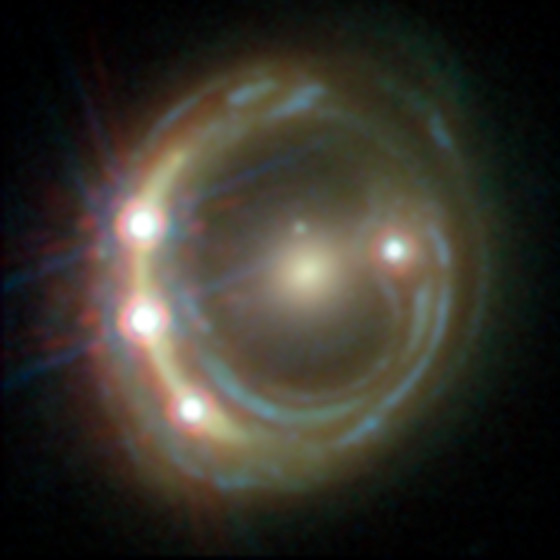
Credit: ESA/Hubble, NASA, Suyu et al. · Image source · Reuse information
Image details
Hubble Space Telescope / ACS / NICMOS; V (555 nm), I (814 nm), H (1.6 μm)
Field of view: 0.12 × 0.12 arcmin
CC BY 4.0; retain the full image credit; publisher JPEG unchanged
- Other names
- 1RXS J113155.4-123155 [1]
Name origin
Sluse et al. (2003), A quadruply imaged quasar with an optical Einstein ring candidate: 1RXS J113155.4−123155.Name variants and source provenance
Published spellings and paper abbreviations retained for matching and traceability.
RX J1131−1231 [3]ESA/Hubble (2017), Lensed quasar, heic1702d.
RX J1131-1231 [2]Claeskens et al. (2006), Multi wavelength study of the gravitational lens system RXS J1131−1231. II. Lens model and source reconstruction.
- Catalog source
- Cited Paper
- Right ascension
- 172.96445621°
11h 31m 51.47s [1] - Declination
- -12.53234944°
−12° 31′ 56.46″ - Coordinates
- Equatorial J2000 · adopted catalog position
- Lens → Source
- Galaxy → Quasar [1]
- Appearance
- Quadruple image [2]Ring [2]
- Lens redshift
- 0.295 [1]
Measurement details
Reported uncertainty: −0.002 / +0.002
Method: Published adopted spectroscopic redshift
Source location: Section 3: galaxy absorption-line spectroscopy
- Discovery report
- Not available
Background sources
One active galaxy: quasar images A–D and extended host ring [1]
- Source redshift
- 0.658 [1]
Measurement details
Reported uncertainty: −0.001 / +0.001
Method: Published adopted spectroscopic redshift
Source location: Section 3: Mg II and [O III] emission lines; discovery-paper value
- Einstein radius
- 1.819 arcsec [1]
Measurement details
Reported uncertainty: −0.006 / +0.006
Method: Singular isothermal sphere plus external shear lens model
Source location: Section 4: SIS plus external-shear model; model-dependent radius and Monte Carlo uncertainty
Evidence & coordinate notes
- Confirmation: Published spectroscopy and gravitational lens interpretation; see cited paper. [1]
- Coordinates: Sluse et al. Table 1: coarse absolute image-A position 11h31m51.6s −12°31′57″ plus MCS G−A offsets ΔRA cos(Dec)=−1.911 arcsec, ΔDec=+0.542 arcsec; derived approximate lens centre. Absolute precision is limited by the rounded image-A position. Converted to decimal degrees; conversion digits do not imply additional astrometric accuracy. [1]
- Description: Abstract: quad AGN, bright Einstein ring and reconstructed host galaxy. [2]
- System class: Foreground deflector and background source types described in the cited work. [1]