Catalog ID: GLC-229
SDSS_J230321.72+142217.9
SDSS J230321.72+142217.9 is a confirmed SLACS galaxy–galaxy lens. Foreground and background spectral features, Hubble imaging and lens modelling support one primary background galaxy; its multiple images are not separate physical sources. It was publicly reported as a spectroscopic lens candidate on 3 November 2003, before the 2005 SLACS confirmation report. The adopted angular Einstein radius is the effective radius enclosing the same area as the model tangential critical curve. The quoted likelihood-capped interval includes noise and source-discretization uncertainty, but excludes systematic error from a mismatch between the assumed mass model and the true mass distribution. [3] [1] [5]
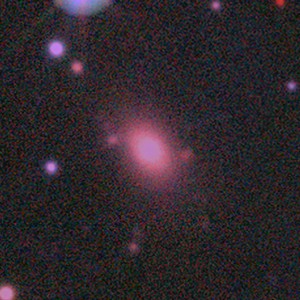
Credit: Legacy Surveys / D. Lang (Perimeter Institute) · Image source · Reuse information
Image details
/ ;
Creative Commons Attribution 4.0 International (CC BY 4.0)
- Other names
- No additional distinct designations
Name variants and source provenance
Published spellings and paper abbreviations retained for matching and traceability.
SDSS_J230321.72+142217.9 [1]SLACS
- Catalog source
- SLACS
- Right ascension
- 23h 03m 21.72s
23h 03m 21.72s [1] - Declination
- +14° 22′ 17.9″
+14° 22′ 17.90″ - Coordinates
- Equatorial J2000 · adopted catalog position
- Lens → Source
- Galaxy → Galaxy [2]
- Appearance
- Not yet classified
- Lens redshift
- 0.1553 [2]
Measurement details
No individual redshift error or confidence interval is tabulated; decimal precision is not an uncertainty.
Method: SDSS spectroscopy
Source location: arXiv:0805.1931v1 Appendix A Table 4 continued, J2303+1422, spectrum 0743-52262-304, zFG/zBG columns.
- Discovery report
- 2003-11-03 [3]
Background sources
Primary background galaxy [1]
- Source redshift
- 0.5170 [2]
Measurement details
No individual redshift error or confidence interval is tabulated. Multiple-line selection supports identification independently of lens confirmation.
Method: SDSS multiple nebular emission-line spectroscopy
Source location: arXiv:0805.1931v1 Appendix A Table 4 continued, J2303+1422, spectrum 0743-52262-304, zFG/zBG columns.
- Einstein radius
- 1.628 arcsec [5]
Measurement details
Reported uncertainty: −0.005 / +0.007
68.7% posterior credible region (global convention §5.4; §6.2.1 describes 68%). Likelihood cap addresses noise/source discretization. Does not include systematic error due to mismatch of assumed mass model and true mass distribution.
Method: PyAutoLens power-law ellipsoidal mass + external shear; effective radius sqrt(A/pi) of tangential critical curve
Source location: arXiv:2202.09201v2 Table 2, J2303+1422, R_Ein,eff; §2.1 Eq.5 definition; §5.4 interval convention; §6.2.1 systematic limitation.
Evidence & coordinate notes
- Confirmation: arXiv:astro-ph/0511453v2 Table 1, J2303+1422 row; §§II.1 and III (spectral selection, lens-model confirmation and background galaxies). [1]
- Confirmation: arXiv:0805.1931v1 Appendix A Table 4 continued, J2303+1422 E-S-A row; §III multiplicity definition, §V.1 grade A, §V.2 galaxy SIE model; Table 5 continued same target. [2]
- Coordinates: arXiv:astro-ph/0511453v2 Table 1, SDSS J230321.72+142217.9 row and J2000 truncated-name note. [1]
- Description: arXiv:astro-ph/0311055v1 Table 1, SDSS J230321.72+142217.9, spectrum 0743-52262-304; arXiv submission history v1 2003-11-03 (candidate report). [3]
- Description: arXiv:astro-ph/0511453v2 Table 1, J2303+1422 row; §§II.1 and III (spectral selection, lens-model confirmation and background galaxies). [1]
- Description: arXiv:2202.09201v2 Table 2, J2303+1422, R_Ein,eff; §2.1 Eq.5 definition; §5.4 interval convention; §6.2.1 systematic limitation. [5]
- Discovery date: arXiv:astro-ph/0311055v1 Table 1, SDSS J230321.72+142217.9, spectrum 0743-52262-304; arXiv submission history v1 2003-11-03 (candidate report). [3]
- Einstein radius: arXiv:2202.09201v2 Table 2, J2303+1422, R_Ein,eff; §2.1 Eq.5 definition; §5.4 interval convention; §6.2.1 systematic limitation. [5]
- Lens redshift: arXiv:0805.1931v1 Appendix A Table 4 continued, J2303+1422, spectrum 0743-52262-304, zFG/zBG columns. [2]
- Source:source 1: arXiv:astro-ph/0511453v2 Table 1, J2303+1422 row; §§II.1 and III (spectral selection, lens-model confirmation and background galaxies). [1]
- Source redshift: arXiv:0805.1931v1 Appendix A Table 4 continued, J2303+1422, spectrum 0743-52262-304, zFG/zBG columns. [2]
- System class: arXiv:0805.1931v1 Appendix A Table 4 continued, J2303+1422 E-S-A row; §III multiplicity definition, §V.1 grade A, §V.2 galaxy SIE model; Table 5 continued same target. [2]
References
- Bolton et al. (2006), The Sloan Lens ACS Survey. I. A Large Spectroscopically Selected Sample of Massive Early-Type Lens Galaxies. DOI: 10.1086/498884
- Bolton et al. (2008), The Sloan Lens ACS Survey. V. The Full ACS Strong-Lens Sample. DOI: 10.1086/589327
- Bolton et al. (2004), Sloan Digital Sky Survey Spectroscopic Lens Search. I. Discovery of Intermediate-Redshift Star-Forming Galaxies Behind Foreground Luminous Red Galaxies; initial public manuscript 2003. DOI: 10.1086/382714
- Czoske et al. (2012), Two-dimensional kinematics of SLACS lenses - IV. The complete VLT-VIMOS data set. DOI: 10.1111/j.1365-2966.2011.19726.x
- Etherington et al. (2022), Automated galaxy-galaxy strong lens modelling: no lens left behind; revised manuscript v2 (2023). DOI: 10.1093/mnras/stac2639