Catalog ID: GLC-220
SDSS_J125135.70-020805.1
Confirmed — combined [1]
SDSS J125135.70-020805.1 is a SLACS lens with one adopted background galaxy. Spectral foreground/background separation and the published lens-imaging assessment support confirmation; multiple images are not treated as separate physical sources. The foreground object has a bulge-dominated spiral structure. Its lensing is attributed to the bulge, supporting a galaxy–galaxy lens classification despite its exclusion from some early-type-galaxy statistics. [1]
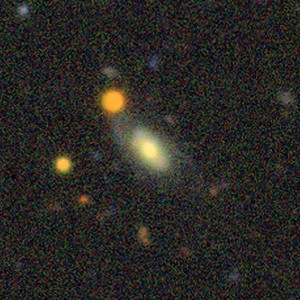
Credit: Legacy Surveys / D. Lang (Perimeter Institute) · Image source · Reuse information
Image details
/ ;
Creative Commons Attribution 4.0 International (CC BY 4.0)
- Other names
- No additional distinct designations
Name variants and source provenance
Published spellings and paper abbreviations retained for matching and traceability.
SDSS_J125135.70-020805.1 [1]SLACS
- Catalog source
- SLACS
- Right ascension
- 12h 51m 35.70s
12h 51m 35.70s [1] - Declination
- -02° 08′ 05.1″
−02° 08′ 05.10″ - Coordinates
- Equatorial J2000 · adopted catalog position
- Lens → Source
- Galaxy → Galaxy [2]
- Appearance
- Not yet classified
- Lens redshift
- 0.2243 [2]
Measurement details
No individual redshift uncertainty is tabulated in this source; reported digits do not define an error bar.
Method: SDSS spectroscopy
Source location: arXiv:0805.1931v1 Appendix A Table 4, J1251-0208 (same SDSS spectrum as SLACS I); §V.1 classification definitions.
- Discovery report
- 2005-11-15 [3]
Background sources
Primary background galaxy [1]
- Source redshift
- 0.7843 [2]
Measurement details
No individual redshift uncertainty is tabulated in this source; reported digits do not define an error bar.
Method: SDSS spectroscopy
Source location: arXiv:0805.1931v1 Appendix A Table 4, J1251-0208 (same SDSS spectrum as SLACS I); §V.1 classification definitions.
- Einstein radius
- 0.84 arcsec [2]
Measurement details
Individual error not supplied. Table 3 estimates 2% fractional RMS model uncertainty across the sample; it is not a target-specific Gaussian error bar.
Method: Singular isothermal ellipsoid, intermediate-axis radius
Source location: Table 5 J1251-0208, b_SIE; §V.2; §VI.1 and Table 3.
Evidence & coordinate notes
- Confirmation: arXiv:astro-ph/0511453v2 Table 1 row J1251-0208; §III lens identification; Appendix B.1 target entry. [1]
- Coordinates: Table 1, SDSS J125135.70-020805.1 row, System Name and Plate-MJD-Fiber columns; table note defines truncated J2000 HHMMSS.ss±DDMMSS.s [1]
- Description: arXiv:astro-ph/0511453v2 Table 1 row J1251-0208; §III lens identification; Appendix B.1 target entry. [1]
- Discovery date: arXiv:astro-ph/0511453v1 Table 1 row J1251-0208; arXiv v1 history 2005-11-15. [3]
- Einstein radius: Table 5 J1251-0208, b_SIE; §V.2; §VI.1 and Table 3. [2]
- Lens redshift: arXiv:0805.1931v1 Appendix A Table 4, J1251-0208 (same SDSS spectrum as SLACS I); §V.1 classification definitions. [2]
- Source:source 1: arXiv:astro-ph/0511453v2 Table 1 row J1251-0208; §III lens identification; Appendix B.1 target entry. [1]
- Source redshift: arXiv:0805.1931v1 Appendix A Table 4, J1251-0208 (same SDSS spectrum as SLACS I); §V.1 classification definitions. [2]
- System class: arXiv:0805.1931v1 Appendix A Table 4, J1251-0208 (same SDSS spectrum as SLACS I); §V.1 classification definitions. [2]
References
- The Sloan Lens ACS Survey. I. A Large Spectroscopically Selected Sample of Massive Early-Type Lens Galaxies (https://arxiv.org/abs/astro-ph/0511453v2). DOI: 10.1086/498884
- Bolton et al. (2008), The Sloan Lens ACS Survey. V. The Full ACS Strong-Lens Sample. DOI: 10.1086/589327
- Bolton et al., SLACS I, initial public report, arXiv:astro-ph/0511453v1 (2005-11-15).