Catalog ID: GLC-218
SDSS_J073728.45+321618.5
Confirmed — combined [1]
SDSS J073728.45+321618.5 is a SLACS lens with one adopted background galaxy. Spectral foreground/background separation and the published lens-imaging assessment support confirmation; multiple images are not treated as separate physical sources. The adopted angular lensing scale is the later effective Einstein radius from the area enclosed by the tangential critical curve. Its statistical credible interval does not include uncertainty from the assumed mass model. [1] [4]
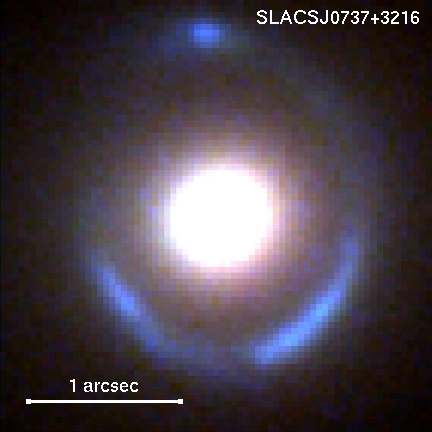
Credit: NASA, ESA, and P. Marshall and T. Treu (University of California, Santa Barbara) · Image source · Reuse information
Image details
Hubble Space Telescope; Keck II / ;
NASA imagery: informational use permitted under NASA media guidelines
- Other names
- SLACS J0737+3216 [5]
Name origin
NASA/HubbleName variants and source provenance
Published spellings and paper abbreviations retained for matching and traceability.
SDSS_J073728.45+321618.5 [1]SLACS
- Catalog source
- SLACS
- Right ascension
- 07h 37m 28.45s
07h 37m 28.45s [1] - Declination
- +32° 16′ 18.5″
+32° 16′ 18.50″ - Coordinates
- Equatorial J2000 · adopted catalog position
- Lens → Source
- Galaxy → Galaxy [2]
- Appearance
- Not yet classified
- Lens redshift
- 0.3223 [2]
Measurement details
No individual redshift uncertainty is tabulated in this source; reported digits do not define an error bar.
Method: SDSS spectroscopy
Source location: arXiv:0805.1931v1 Appendix A Table 4, J0737+3216 (same SDSS spectrum as SLACS I); §V.1 classification definitions.
- Discovery report
- 2003-11-03 [3]
Background sources
Primary background galaxy [1]
- Source redshift
- 0.5812 [2]
Measurement details
No individual redshift uncertainty is tabulated in this source; reported digits do not define an error bar.
Method: SDSS spectroscopy
Source location: arXiv:0805.1931v1 Appendix A Table 4, J0737+3216 (same SDSS spectrum as SLACS I); §V.1 classification definitions.
- Einstein radius
- 0.976 arcsec [4]
Measurement details
Reported uncertainty: −0.002 / +0.003
Asymmetric 68.7% credible intervals from likelihood-capped inference. Does not include systematic error from mismatch between assumed and true mass distributions.
Method: PLEMD plus external shear; effective radius from area inside tangential critical curve
Source location: arXiv:2202.09201v2 visible Table 2, J0737+3216; §2.1 equation (5), §2.2, §5.4 and §6.2.1.
Evidence & coordinate notes
- Confirmation: arXiv:astro-ph/0511453v2 Table 1 row J0737+3216; §III lens identification. [1]
- Coordinates: Table 1, SDSS J073728.45+321618.5 row, System Name and Plate-MJD-Fiber columns; table note defines truncated J2000 HHMMSS.ss±DDMMSS.s [1]
- Description: arXiv:astro-ph/0511453v2 Table 1 row J0737+3216; §III lens identification. [1]
- Description: arXiv:2202.09201v2 visible Table 2, J0737+3216; §2.1 equation (5), §2.2, §5.4 and §6.2.1. [4]
- Discovery date: arXiv:astro-ph/0311055v1 Table 1 spectrum 0541-51959-145; arXiv v1 history 2003-11-03. Candidate report, not confirmation date. [3]
- Einstein radius: arXiv:2202.09201v2 visible Table 2, J0737+3216; §2.1 equation (5), §2.2, §5.4 and §6.2.1. [4]
- Lens redshift: arXiv:0805.1931v1 Appendix A Table 4, J0737+3216 (same SDSS spectrum as SLACS I); §V.1 classification definitions. [2]
- Source:source 1: arXiv:astro-ph/0511453v2 Table 1 row J0737+3216; §III lens identification. [1]
- Source redshift: arXiv:0805.1931v1 Appendix A Table 4, J0737+3216 (same SDSS spectrum as SLACS I); §V.1 classification definitions. [2]
- System class: arXiv:0805.1931v1 Appendix A Table 4, J0737+3216 (same SDSS spectrum as SLACS I); §V.1 classification definitions. [2]
References
- The Sloan Lens ACS Survey. I. A Large Spectroscopically Selected Sample of Massive Early-Type Lens Galaxies (https://arxiv.org/abs/astro-ph/0511453v2). DOI: 10.1086/498884
- Bolton et al. (2008), The Sloan Lens ACS Survey. V. The Full ACS Strong-Lens Sample. DOI: 10.1086/589327
- Bolton et al. (2004), Sloan Digital Sky Survey Spectroscopic Lens Search. I. Discovery of Intermediate-Redshift Star-Forming Galaxies Behind Foreground Luminous Red Galaxies; initial public version 2003-11-03. DOI: 10.1086/382714
- Etherington et al., Automated galaxy-galaxy strong lens modelling: no lens left behind, arXiv:2202.09201v2 (2023 revision); MNRAS DOI 10.1093/mnras/stac2639. DOI: 10.1093/mnras/stac2639
- NASA/Hubble: Hubble/Keck Composite Image of Gravitational Lens System SLACS J0737+3216.