Catalog ID: GLC-216
AGEL013322-125201A
Confirmed — published expert assessment [1]
AGEL013322-125201A is an AGEL DR2 imaging lens with one adopted primary background source A. Its gray-bordered Figure 4 entry has no AGEL redshift measurement. Confirmation here follows the published imaging assessment; it does not imply spectroscopic confirmation. Jacobs et al. reported this candidate in 2019 and list a foreground photometric redshift of 0.71, without an individual uncertainty. The galaxy–galaxy classification is inferred from its unflagged CNN-search context, rather than a measured mass threshold. [1] [3]
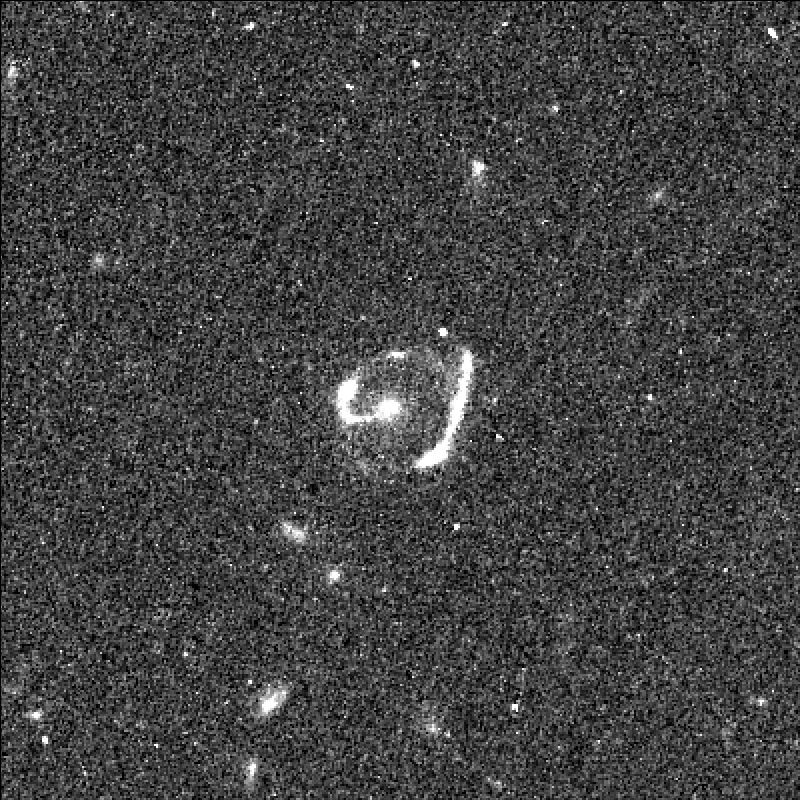
Credit: Tania Barone / AGEL Survey; HST program 17307 (PI Tran) · Image source · Reuse information
Image details
Hubble Space Telescope / ACS; F606W
CC0 1.0 Universal
- Other names
- DCLS0133-1252 [1]
Name origin
AGEL DR2Name variants and source provenance
Published spellings and paper abbreviations retained for matching and traceability.
AGEL013322-125201A [1]AGEL DR2
- Catalog source
- AGEL
- Right ascension
- 23.34212°
01h 33m 22.11s [2] - Declination
- -12.86700°
−12° 52′ 01.20″ - Coordinates
- Equatorial J2000 · adopted catalog position
- Lens → Source
- Galaxy → Galaxy [3]
- Appearance
- Not yet classified
- Lens redshift
- 0.71 [3]
Measurement details
No object-specific uncertainty reported in this table; decimal precision is not an error bar.
Method: DES BPZ photometric redshift
Source location: Final Table 1 machine-readable row DESJ0133-1252, object 229855710; redshift and flag definitions in Table 1 note; §2.1 p.3, §2.4 pp.5–6, §2.5 p.6, §3.5 p.8; final Table 1 p.3 notes.
- Discovery report
- 2019-05-25 [4]
Background sources
Primary background source A [1]
- Source redshift
- Not available
- Einstein radius
- Not available
Evidence & coordinate notes
- Confirmation: Final AJ 171:57, Figure 4 p.12 position 44; §2.2 p.13; source naming convention p.4. [1]
- Coordinates: dbf4.txt position 44, AGEL013322-125201A; RAdeg/DEdeg J2000 column definitions. [2]
- Description: Final AJ 171:57, Figure 4 p.12 position 44; §2.2 p.13; source naming convention p.4. [1]
- Description: Final Table 1 machine-readable row DESJ0133-1252, object 229855710; redshift and flag definitions in Table 1 note; §2.1 p.3, §2.4 pp.5–6, §2.5 p.6, §3.5 p.8; final Table 1 p.3 notes. [3]
- Discovery date: arXiv:1905.10522v1 Table 3 row DESJ0133-1252, object 229855710; arXiv v1 submission history 2019-05-25. [4]
- Lens redshift: Final Table 1 machine-readable row DESJ0133-1252, object 229855710; redshift and flag definitions in Table 1 note; §2.1 p.3, §2.4 pp.5–6, §2.5 p.6, §3.5 p.8; final Table 1 p.3 notes. [3]
- Source:source a: Final AJ 171:57, Figure 4 p.12 position 44; §2.2 p.13; source naming convention p.4. [1]
- System class: Final Table 1 machine-readable row DESJ0133-1252, object 229855710; redshift and flag definitions in Table 1 note; §2.1 p.3, §2.4 pp.5–6, §2.5 p.6, §3.5 p.8; final Table 1 p.3 notes. [3]
References
- Barone et al. (2026), The AGEL Survey Data Release 2: A Gravitational Lens Sample for Galaxy Evolution and Cosmology, AJ 171, 57. Published 2025-12-24. DOI: 10.3847/1538-3881/ae1f86
- Barone et al., final Figure 4 machine-readable data, dbf4.txt.
- Jacobs et al. (2019), An Extended Catalog of Galaxy–Galaxy Strong Gravitational Lenses Discovered in DES Using Convolutional Neural Networks, ApJS 243, 17; final article and machine-readable Table 1. DOI: 10.3847/1538-4365/ab26b6
- Jacobs et al., original public manuscript arXiv:1905.10522v1, submitted 2019-05-25.