Catalog ID: GLC-210
AGEL030416-492126A
Confirmed — published expert assessment [1]
AGEL030416-492126A is an AGEL DR2 imaging lens with one adopted primary background source A. Its gray-bordered Figure 4 entry has no AGEL redshift measurement. Confirmation here follows the published imaging assessment; it does not imply spectroscopic confirmation. The associated ACT-CL J0304-4921 field has a primary 2010 report explicitly identifying newly reported strong-lensing arcs. The wide cluster arcs have not been individually mapped to AGEL source A here. This leaves the source-A angular lensing radius and the applicable mass-scale classification unspecified. The adopted report date is the 2025 public AGEL source-A entry; the 2010 cluster-arc report is retained as earlier field history, without assigning those arcs to source A. Foreground alternatives in the inspected reports include 0.47 ± 0.05 in Menanteau et al., 0.34 in Jacobs et al., and a rounded photometric 0.38 in O’Donnell et al. They are retained without adopting one or attributing the discrepancy to a particular cause. The photometric image entries are not adopted as source-A redshifts. [1] [6] [4] [3] [5]
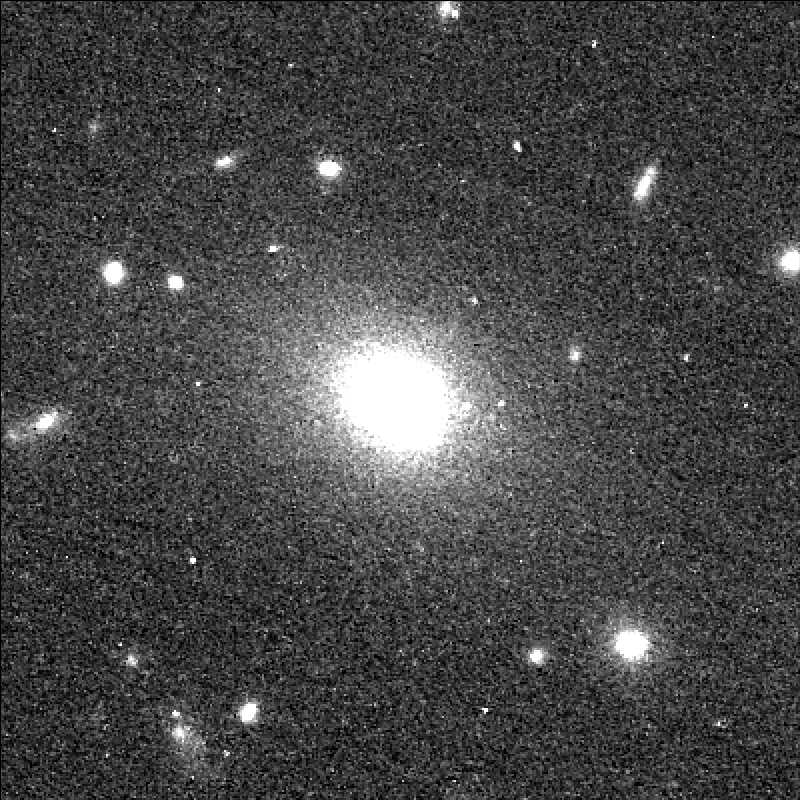
Credit: Tania Barone / AGEL Survey; HST program 17307 (PI Tran) · Image source · Reuse information
Image details
Hubble Space Telescope / ACS; F606W
CC0 1.0 Universal
- Other names
- DES0304-4921 [1]
Name origin
AGEL DR2Name variants and source provenance
Published spellings and paper abbreviations retained for matching and traceability.
AGEL030416-492126A [1]AGEL DR2
- Catalog source
- AGEL
- Right ascension
- 46.06730°
03h 04m 16.15s [2] - Declination
- -49.35724°
−49° 21′ 26.06″ - Coordinates
- Equatorial J2000 · adopted catalog position
- Lens → Source
- Not yet classified
- Appearance
- Not yet classified
- Lens redshift
- Not available
- Discovery report
- 2025-03-11 [6]
- Explore
- External object viewer
Background sources
Primary background source A [1]
- Source redshift
- Not available
- Einstein radius
- Not available
Evidence & coordinate notes
- Confirmation: Final AJ 171:57, Figure 4 p.12 position 38; §2.2 p.13; source naming convention p.4. [1]
- Coordinates: dbf4.txt position 38, AGEL030416-492126A; RAdeg/DEdeg J2000 column definitions. [2]
- Description: Final AJ 171:57, Figure 4 p.12 position 38; §2.2 p.13; source naming convention p.4. [1]
- Description: arXiv:2503.08041v1 visible Table A2, position 37 AGEL030416-492126A; v1 submission history 2025-03-11. [6]
- Description: Jacobs final Table 1 row DESJ0304-4921, object 341631765 and Table 1 redshift/flag notes. [4]
- Description: arXiv:1006.5126v1 §IV.2, first-report paragraph and Figure 11; Tables 2 and 3 ACT-CL J0304-4921 rows. [3]
- Description: O’Donnell Table 3 DESJ0304-4921; machine-readable Table 4 component A and image rows 1–3; §4. [5]
- Discovery date: arXiv:2503.08041v1 visible Table A2, position 37 AGEL030416-492126A; v1 submission history 2025-03-11. [6]
- Source:source a: Final AJ 171:57, Figure 4 p.12 position 38; §2.2 p.13; source naming convention p.4. [1]
References
- Barone et al. (2026), The AGEL Survey Data Release 2: A Gravitational Lens Sample for Galaxy Evolution and Cosmology, AJ 171, 57. Published 2025-12-24. DOI: 10.3847/1538-3881/ae1f86
- Barone et al., final Figure 4 machine-readable data, dbf4.txt.
- The Atacama Cosmology Telescope: Physical Properties and Purity of a Galaxy Cluster Sample Selected via the Sunyaev-Zel'dovich Effect (https://arxiv.org/abs/1006.5126v1). DOI: 10.1088/0004-637X/723/2/1523
- Jacobs et al. (2019), An Extended Catalog of Galaxy–Galaxy Strong Gravitational Lenses Discovered in DES Using Convolutional Neural Networks, ApJS 243, 17; final article and machine-readable Table 1. DOI: 10.3847/1538-4365/ab26b6
- O’Donnell et al. (2022), The Dark Energy Survey Bright Arcs Survey: Candidate Strongly Lensed Galaxy Systems from the Dark Energy Survey 5000 Square Degree Footprint. DOI: 10.3847/1538-4365/ac470b
- Barone et al. (2025), AGEL DR2, arXiv:2503.08041v1.