Catalog ID: GLC-193
AGEL102643-023319A
Confirmed — published expert assessment [1]
AGEL102643-023319A is included in the AGEL Hubble imaging lens sample. Its AGEL entry has no reported deflector or source redshift; lensing qualification here rests on the published imaging assessment. DELVE first listed this field as a probable galaxy–galaxy lens candidate. Its catalog size estimate comes from image separations and is not adopted here as a modeled Einstein radius. [1] [2] [4] [3]
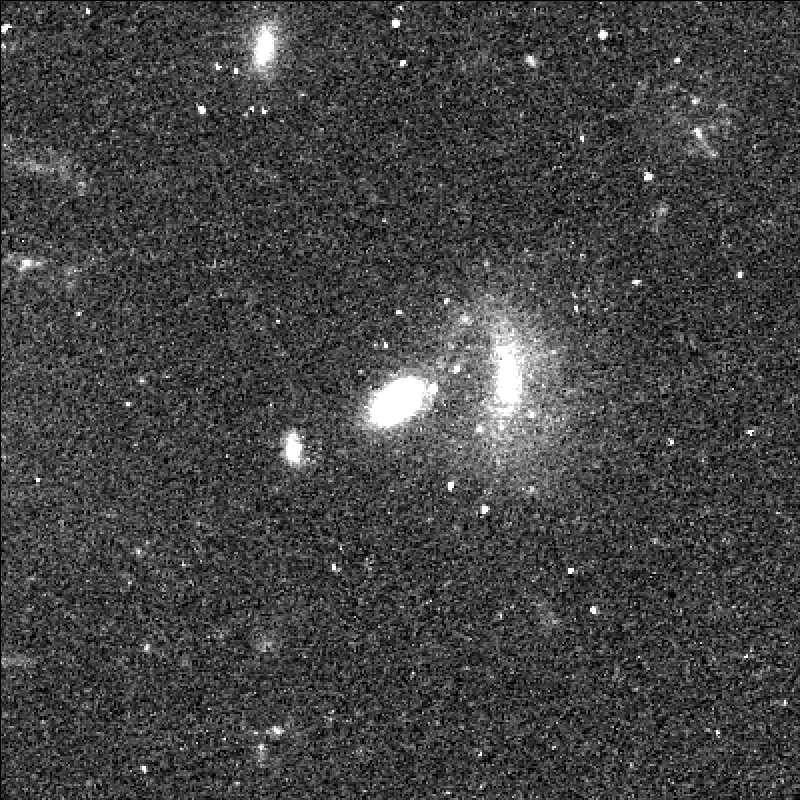
Credit: Tania Barone / AGEL Survey; Hubble Space Telescope program 17307 (PI Tran). · Image source · Reuse information
Image details
Hubble Space Telescope / ACS/WFC; F606W
CC0 1.0 Universal
- Other names
- DELJ102643-023319 [1]
Name origin
Published HST cross-identification in AGEL DR2Name variants and source provenance
Published spellings and paper abbreviations retained for matching and traceability.
AGEL102643-023319A [1]AGEL DR2
- Catalog source
- AGEL
- Right ascension
- 156.67940°
10h 26m 43.06s [2] - Declination
- -2.55540°
−02° 33′ 19.44″ - Coordinates
- Equatorial J2000 · adopted catalog position
- Lens → Source
- Galaxy → Galaxy [4] [3]
- Appearance
- Not yet classified
- Lens redshift
- Not available
- Discovery report
- 2022 [5]
Background sources
Primary background source A [1]
- Source redshift
- Not available
- Einstein radius
- Not available
Evidence & coordinate notes
- Confirmation: Final AJ Figure 4 p.12, position 17, AGEL102643-023319A; §2.2 p.13 explicitly retains 45 observed lenses after named exclusions. Target is absent from program17307 non-lens/data-failure exclusions in Table 2 p.13 and false positives in Table 3 p.18. [1]
- Coordinates: dbf4.txt line 45, Position 17, AGEL102643-023319A / DELJ102643-023319; byte definitions RAdeg/DEdeg lines 20–21, J2000 decimal degrees; redshift color note lines 23–27. [2]
- Description: Final AJ Figure 4 p.12, position 17, AGEL102643-023319A, with gray-border caption; §2.2 p.13 retained imaging lens sample; Table 2 p.13 and Table 3 p.18 exclusions checked for this target. [1]
- Description: dbf4.txt line 45, position 17, AGEL102643-023319A: Grey; Note (1), lines 23–27, means no deflector/source redshifts in AGEL, not absence of external measurements. [2]
- Description: Final ApJ §3.4 pp.9–10 (candidate grading), §4.1 p.11 (average image–lens separations used as radius estimates); Table B1 p.21 (electronic-table column definitions). [4]
- Description: apjace4bat2_mrt.txt line 331, DELJ102643-023319, type=lens, grade B; associated source rows follow; Table B1 p.21 definitions. [3]
- Discovery date: Original v1 Figure A.2 p.20, row5 column1 DELJ102643-023319; neither panel has the red prior-discovery outline; original submission19October2022. [5]
- Source:primary: p.4 A/B/C physical-source convention; Figure 4 p.12 position 17, AGEL102643-023319A; no secondary-source assignment. [1]
- System class: Final ApJ abstract p.2 and §4.3 p.14: search tuned to galaxy–galaxy lenses with eight named quasar exceptions; neither target is an exception. Table B1 p.21 defines lens/source rows; Figure B2 p.18 exact labeled Grade B panels. [4]
- System class: apjace4bat2_mrt.txt line 331, DELJ102643-023319, type=lens, grade B; associated source rows follow; Table B1 p.21 definitions. [3]
References
- Barone et al. (2026), The AGEL Survey Data Release 2, AJ 171:57; final published edition DOI: 10.3847/1538-3881/ae1f86
- Barone et al., final Figure 4 machine-readable data, dbf4.txt
- Zaborowski et al. (2023), full machine-readable table; described in Table B1 p.21
- Zaborowski et al. (2023), Identification of Galaxy–Galaxy Strong Lens Candidates in DELVE, ApJ 954:68 DOI: 10.3847/1538-4357/ace4ba
- Zaborowski et al., original public manuscript, arXiv:2210.10802v1, 19 October 2022