Catalog ID: GLC-19
AGEL224405+275916A
AGEL224405+275916A is an AGEL gravitational lens with one catalogued primary background source. The environment study classifies its enclosed lensing mass as group-scale while its visual assessment identifies a galaxy-scale deflector; the catalog system class is left unresolved. [1] [3]
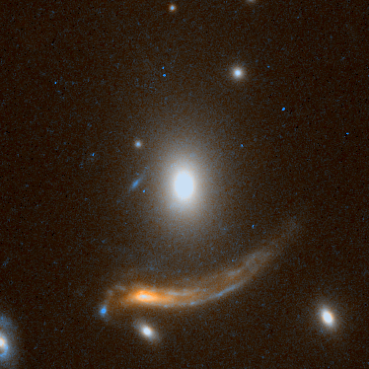
Credit: Tania Barone / AGEL Survey; HST program 16773 (PI Karl Glazebrook); reduced data: Hannah Skobe · Image source · Reuse information
Image details
Hubble Space Telescope / WFC3/UVIS; WFC3/IR; F200LP; F140W
CC0 1.0
- Other names
- CSWA129 [2]
Name origin
Official AGEL/HST mappingName variants and source provenance
Published spellings and paper abbreviations retained for matching and traceability.
AGEL224405+275916A [2]Official AGEL/HST mapping
- Catalog source
- AGEL
- Right ascension
- 341.0206°
22h 44m 04.94s [2] - Declination
- 27.9877°
+27° 59′ 15.72″ - Coordinates
- Equatorial J2000 · adopted catalog position
- Lens → Source
- Not yet classified
- Appearance
- Not yet classified
- Lens redshift
- 0.343 [1]
Measurement details
Literature measurement marked with a caret in Table 1. No uncertainty supplied in this row; DR2 formal new-measurement error is not transferred to it.
Method: SDSS spectroscopic literature value compiled in DR2
Source location: Table 1 p.9, AGEL224405+275916A; section 3.1 pp.14-16
- Discovery report
- Not available
- Explore
- External object viewer
Background sources
AGEL224405+275916A background source A [1]
- Source redshift
- 0.960 [1]
Measurement details
Reported uncertainty: −0.0005 / +0.0005
Reliable multiple-feature measurement in the survey. Formal error excludes possible tracer/rotation systematics discussed in section 3.1.
Method: Keck/ESI spectroscopy; Gaussian feature fits or MARZ templates (survey methods)
Source location: Table 1 p.9, AGEL224405+275916A; section 3.1 pp.14-16
- Einstein radius
- 5.3 arcsec [3]
Measurement details
Reported uncertainty: −1.8 / +1.8
Approximate image-position radius; not a precision HST mass-model parameter. Errors include measurement method limitations described in section 3.3.
Method: MCMC ring/line fit to source-image positions/light in DECaLS imaging
Source location: Table 4 p.17, AGEL224405+275916; section 3.3.1
Evidence & coordinate notes
- Confirmation: Table 1 p.9, AGEL224405+275916A; Figure 3 p.11 includes the named HST-program lens; section 3.1 distinguishes spectral quality from lensing. [1]
- Confirmation: Table 4 p.17, AGEL224405+275916; abstract/section 2: sample of spectroscopically confirmed strong lenses. [3]
- Coordinates: AGEL_HST_objnames.tab line 75 (AGEL224405+275916A / CSWA129); RAJ2000, DECJ2000 columns; catalog lens-system position, not source-plane astrometry. [2]
- Description: Table 1 p.9, AGEL224405+275916A; section 3.1 pp.14-16 (redshift methods and limitations). [1]
- Description: Table 4 p.17, AGEL224405+275916; section 3.3.4 mass thresholds; Table 2 note defines visual scale; distinct mass-based and visual deflector scales, not environment membership. [3]
- Source:a: Table 1 p.9, AGEL224405+275916A; physical A/B naming explained p.4 and Table 1 note p.10. [1]
References
- Barone et al. (2026), The AGEL Survey Data Release 2, AJ 171, 57; final published article. DOI: 10.3847/1538-3881/ae1f86
- AGEL Survey, AGEL_HST_objnames.tab, Harvard Dataverse v1.0.
- Gottemoller et al. (2026), Most Strong Lensing Deflectors in the AGEL Survey Are in Group and Cluster Environments, AJ 171, 218; revised v2. DOI: 10.3847/1538-3881/ae4480