Catalog ID: GLC-187
AGEL041810-545735A
Confirmed — published expert assessment [1]
AGEL041810-545735A (DESJ0418-5457) is retained in the published AGEL HST lens imaging sample. An earlier survey reports an arc radius of 1.97 ± 0.27 arcsec and a catalogue redshift of 0.53. Their checked provenance does not justify adopting a modeled Einstein radius or a secure spectroscopic foreground redshift. [3] [2] [4]
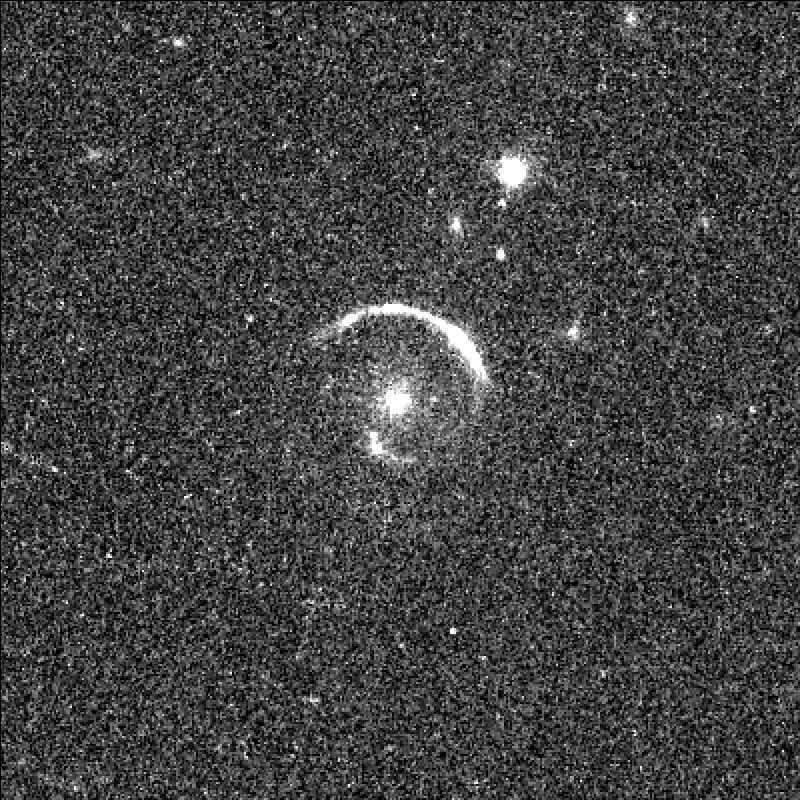
Credit: Tania Barone / AGEL Survey Data Release 2, Harvard Dataverse (doi:10.7910/DVN/ATFVNA); HST program 17307 (PI Kim-Vy Tran). · Image source · Reuse information
Image details
Hubble Space Telescope / ACS/WFC; F606W
CC0 1.0 Universal
- Other names
- DESJ0418-5457 [2]
Name origin
Published HST target cross-identificationName variants and source provenance
Published spellings and paper abbreviations retained for matching and traceability.
AGEL041810-545735A [2]Barone et al. 2026 final figure data
- Catalog source
- AGEL
- Right ascension
- 64.54117°
04h 18m 09.88s [2] - Declination
- -54.95973°
−54° 57′ 35.03″ - Coordinates
- Equatorial J2000 · adopted catalog position
- Lens → Source
- Not yet classified
- Appearance
- Not yet classified
- Lens redshift
- Not available
- Discovery report
- 2017 [3]
- Explore
- External object viewer
Background sources
Primary source A [1]
- Source redshift
- Not available
- Einstein radius
- Not available
Evidence & coordinate notes
- Confirmation: Final Figure 4, exact target panel and row; Section 2 describes retained imaging lenses. Checked exclusions: Table 2 p.13 (data issues), Table 3 p.18 (false positives); selected target is not excluded. [1]
- Coordinates: dbf4.txt line 39, Position 11, AGEL041810-545735A / DESJ0418-5457; byte definitions RAdeg/DEdeg (J2000 degrees), lines 20–21; final Figure 4, PDF p.12. [2]
- Description: Table 2, PDF p.30, DESJ0418-5457: arc radius 1.97 ±0.27 arcsec; Section 4, pp.13–14, mean source-image radius and uncertainty definition; Table 3 introduction p.38, DESDM photometric redshift provenance. [3]
- Description: dbf4.txt line 39, Position 11, AGEL041810-545735A / DESJ0418-5457; byte definitions RAdeg/DEdeg (J2000 degrees), lines 20–21; final Figure 4, PDF p.12. [2]
- Description: Final machine-readable Table 1, line 397, DESJ0418-5457, objectID406587770: z=0.53, r_z=1. Byte definitions lines 27–30 and Notes (1)–(3), lines 32–44. Reference 1 points to Diehl; its photometric provenance does not establish secure spectroscopy. [4]
- Discovery date: Diehl 2017 Table 2 p.30, DES J0418-5457, prior ref b (Nord 2017 in preparation); Jacobs final Table 1 ID406587770 flags a, ref1. An in-preparation citation is not an earlier public report. Adopt supported 2017 report year. [3]
- Source:primary: Final Section 1, PDF p.4, naming convention: A/B/C designate sources; exact final Figure 4 target panel and machine-readable row cited with coordinates. [1]
References
- Barone et al. (2026), The AGEL Survey Data Release 2: A Gravitational Lens Sample for Galaxy Evolution and Cosmology, AJ171,57 (final). DOI: 10.3847/1538-3881/ae1f86
- Barone et al. (2026), final Figure 4 machine-readable data, J2000 target positions and HST names.
- Diehl et al. (2017), The DES Bright Arcs Survey; FERMILAB-PUB-17-138-PPD manuscript (Table 2 pagination cited), published ApJS232,15. DOI: 10.3847/1538-4365/aa8667
- Jacobs et al. (2019), full machine-readable Table 1, apjsab26b6t1_mrt.txt.
- Jacobs et al. (2019), An extended catalog of galaxy-galaxy strong gravitational lenses discovered in DES using convolutional neural networks. DOI: 10.3847/1538-4365/ab26b6