Catalog ID: GLC-185
AGEL001030-431515A
Confirmed — published expert assessment [1]
AGEL001030-431515A (DESJ0010-4315) is retained in the published AGEL HST lens imaging sample. Published modeling describes a fold quadruple with main-deflector Einstein radius 2.78 arcsec, with a 68% credible interval of -0.03/+0.01 arcsec. The foreground redshift 0.84 is photometric. The model’s assumed source redshift of 2 is not a measurement, so the source redshift remains unknown. [2] [3]
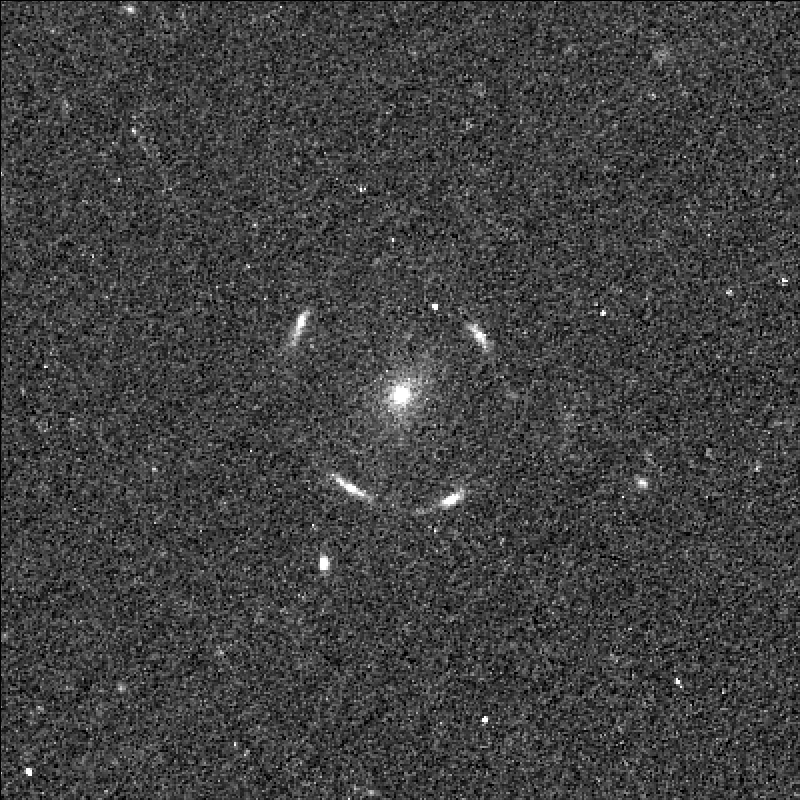
Credit: Tania Barone / AGEL Survey Data Release 2, Harvard Dataverse (doi:10.7910/DVN/ATFVNA); HST program 17307 (PI Kim-Vy Tran). · Image source · Reuse information
Image details
Hubble Space Telescope / ACS/WFC; F606W
CC0 1.0 Universal
- Other names
- DESJ0010-4315 [2]
Name origin
Published HST target cross-identificationName variants and source provenance
Published spellings and paper abbreviations retained for matching and traceability.
AGEL001030-431515A [2]Barone et al. 2026 final figure data
- Catalog source
- AGEL
- Right ascension
- 2.62678°
00h 10m 30.43s [2] - Declination
- -43.25413°
−43° 15′ 14.87″ - Coordinates
- Equatorial J2000 · adopted catalog position
- Lens → Source
- Galaxy → Galaxy [3]
- Appearance
- Quadruple image [3]
- Lens redshift
- 0.84 [3]
Measurement details
No numerical uncertainty quoted for the adopted value; older 0.79 ± 0.35 is retained as an alternative, not its error bar.
Method: Foreground-lens photometric redshift inherited from Jacobs et al. (2019).
Source location: arXiv:2601.15585v1 Table 2 row2, DESJ0010-4315; Section 4.2 photometric/spectroscopic provenance.
- Discovery report
- 2018-11-09 [4]
Background sources
Primary source A [1]
- Source redshift
- Not available
- Einstein radius
- 2.78 arcsec [3]
Measurement details
Reported uncertainty: −0.03 / +0.01
68% posterior credible interval; model parameter for the primary source. Not an observed maximum image separation.
Method: Multi-band PISCO reconstruction with an elliptical power-law main deflector and external shear.
Source location: arXiv:2601.15585v1 Table 2 row2, DESJ0010-4315; Sections 3.3.1 and 4.2.
Evidence & coordinate notes
- Appearance:quadruple: arXiv:2601.15585v1 Appendix A.2, DESJ0010-4315: fold quadruple. [3]
- Confirmation: Final Figure 4, exact target panel and row; Section 2 describes retained imaging lenses. Checked exclusions: Table 2 p.13 (data issues), Table 3 p.18 (false positives); selected target is not excluded. [1]
- Coordinates: dbf4.txt line 37, Position 9, AGEL001030-431515A / DESJ0010-4315; byte definitions RAdeg/DEdeg (J2000 degrees), lines 20–21; final Figure 4, PDF p.12. [2]
- Description: dbf4.txt line 37, Position 9, AGEL001030-431515A / DESJ0010-4315; byte definitions RAdeg/DEdeg (J2000 degrees), lines 20–21; final Figure 4, PDF p.12. [2]
- Description: arXiv:2601.15585v1 Table 2 row2, DESJ0010-4315; Section 4.2 photometric/spectroscopic provenance. arXiv:2601.15585v1 Table 2 row2, DESJ0010-4315; Sections 3.3.1 and 4.2. [3]
- Discovery date: Jacobs arXiv:1811.03786v1 Table 4 p.19, DESJ0010-4315 / ID182452355, grade1 possible candidate. Public v1 metadata: 9 November 2018. Later extended catalogue Table 1 flag d confirms prior CNN provenance. Later HST/model confirmation is distinct. [4]
- Source:primary: Final Section 1, PDF p.4, naming convention: A/B/C designate sources; exact final Figure 4 target panel and machine-readable row cited with coordinates. [1]
- System class: arXiv:2601.15585v1 Table 1 row2; Appendix A.2; Section 5.2. [3]
References
- Barone et al. (2026), The AGEL Survey Data Release 2: A Gravitational Lens Sample for Galaxy Evolution and Cosmology, AJ171,57 (final). DOI: 10.3847/1538-3881/ae1f86
- Barone et al. (2026), final Figure 4 machine-readable data, J2000 target positions and HST names.
- Qu et al. (2026), Multi-band Reconstruction of Sixteen Gravitational Lens Systems using PISCO data, arXiv:2601.15585v1. DOI: 10.1093/mnras/stag153
- Jacobs et al., first public manuscript arXiv:1811.03786v1, 9 November 2018; published 2019. DOI: 10.1093/mnras/stz272
- Jacobs et al. (2019), full machine-readable Table 1, apjsab26b6t1_mrt.txt.
- Jacobs et al. (2019), An extended catalog of galaxy-galaxy strong gravitational lenses discovered in DES using convolutional neural networks. DOI: 10.3847/1538-4365/ab26b6