Catalog ID: GLC-184
AGEL151009+203725A
Confirmed — published expert assessment [1]
AGEL151009+203725A (DESI-227.5364+20.6236) is retained in the published AGEL HST lens imaging sample. Conflicting foreground redshift entries occur in the inspected primary-source editions. Their physical attribution has not been resolved, so the foreground redshift remains unknown. The primary source redshift and Einstein radius also remain unknown; the published HST lens assessment is separate from these measurement uncertainties. [2] [5] [3]
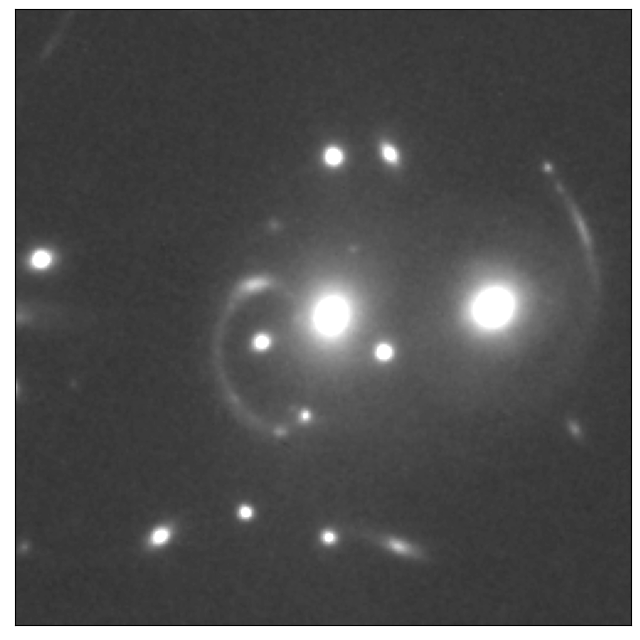
Credit: Tania Barone / AGEL Survey Data Release 2, Harvard Dataverse (doi:10.7910/DVN/ATFVNA); HST program 15867 (PI Xiaosheng Huang). · Image source · Reuse information
Image details
Hubble Space Telescope / WFC3/IR; F140W
CC0 1.0 Universal
- Other names
- DESI-227.5364+20.6236 [2]
Name origin
Published HST target cross-identificationName variants and source provenance
Published spellings and paper abbreviations retained for matching and traceability.
AGEL151009+203725A [2]Barone et al. 2026 final figure data
- Catalog source
- AGEL
- Right ascension
- 227.53640°
15h 10m 08.74s [2] - Declination
- 20.62360°
+20° 37′ 24.96″ - Coordinates
- Equatorial J2000 · adopted catalog position
- Lens → Source
- Not yet classified
- Appearance
- Not yet classified
- Lens redshift
- Not available
- Discovery report
- 2020-05-07 [3]
- Explore
- External object viewer
Background sources
Primary source A [1]
- Source redshift
- Not available
- Einstein radius
- Not available
Evidence & coordinate notes
- Confirmation: Final Figure 5, exact target panel and row; Section 2 describes retained imaging lenses. Checked exclusions: Table 2 p.13 (data issues), Table 3 p.18 (false positives); selected target is not excluded. [1]
- Coordinates: dbf5.txt line 79, Position 51, AGEL151009+203725A / DESI-227.5364+20.6236; byte definitions RAdeg/DEdeg (J2000 degrees), lines 20–21; final Figure 5, PDF p.14. [2]
- Description: dbf5.txt line 79, Position 51, AGEL151009+203725A / DESI-227.5364+20.6236; byte definitions RAdeg/DEdeg (J2000 degrees), lines 20–21; final Figure 5, PDF p.14. [2]
- Description: Grade A project table, index174 (display row175), DESI-227.5364+20.6236; Spec-z [6] blank, Photo-z [7]=0.698±0.020. Conflicts with original 2005.04730v1 Table 1 z=0.584695; attribution unresolved. [5]
- Description: arXiv:2005.04730v1 Table 1 (Grade A), HTML row S7.T1.2.139, DESI-227.5364+20.6236: z=0.584695; compare preserved current Grade A index174, Photo-z=0.698±0.020. Neither adopted. [3]
- Discovery date: Huang arXiv:2005.04730v1 Table 1, exact DESI-227.5364+20.6236 candidate row, independently inspected. Version header and submission history establish 7 May 2020 public report. Current final project table has no prior-reference flag; no universal earliest-discovery claim. [3]
- Source:primary: Final Section 1, PDF p.4, naming convention: A/B/C designate sources; exact final Figure 5 target panel and machine-readable row cited with coordinates. [1]
References
- Barone et al. (2026), The AGEL Survey Data Release 2: A Gravitational Lens Sample for Galaxy Evolution and Cosmology, AJ171,57 (final). DOI: 10.3847/1538-3881/ae1f86
- Barone et al. (2026), final Figure 5 machine-readable data, J2000 target positions and HST names.
- Huang et al., arXiv:2005.04730v1, 7 May 2020, original candidate tables.
- Huang et al. (2021), Discovering New Strong Gravitational Lenses in the DESI Legacy Imaging Surveys; arXiv:2005.04730v3. DOI: 10.3847/1538-4357/abd62b
- Huang et al. (2021), linked Grade A project candidate table; preserved current-table edition inspected 2 November 2026.