Catalog ID: GLC-180
AGEL123736+553343A
Confirmed — combined [1]
AGEL123736+553343A (DESI-189.4008+55.5619) is retained in the published AGEL HST lens imaging sample. This field is independently associated with CSWA13. A foreground group at redshift 0.410 lenses a galaxy whose adopted stellar systemic redshift is 1.86593 ± 0.00024. Alternative nebular and older absorption estimates are retained in the evidence dossier. [2] [4] [3]
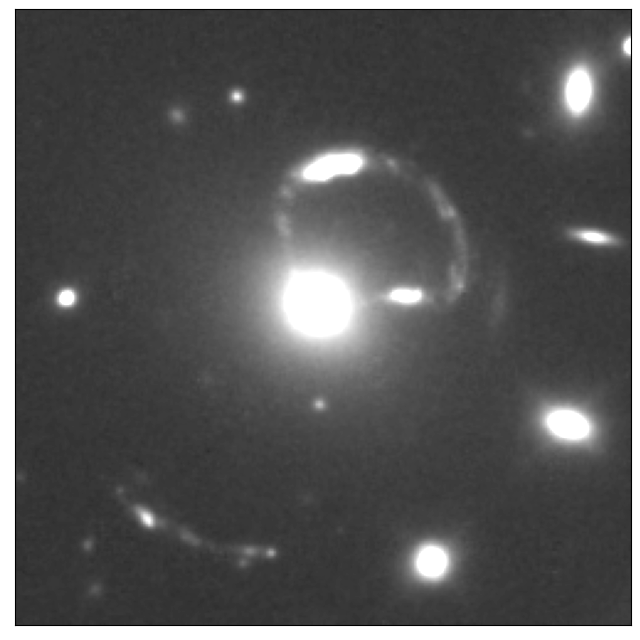
Credit: Tania Barone / AGEL Survey Data Release 2, Harvard Dataverse (doi:10.7910/DVN/ATFVNA); HST program 15867 (PI Xiaosheng Huang). · Image source · Reuse information
Image details
Hubble Space Telescope / WFC3/IR; F140W
CC0 1.0 Universal
- Other names
- DESI-189.4008+55.5619 [2]
Name origin
Published HST target cross-identificationName variants and source provenance
Published spellings and paper abbreviations retained for matching and traceability.
AGEL123736+553343A [2]Barone et al. 2026 final figure data
- Catalog source
- AGEL
- Right ascension
- 189.40080°
12h 37m 36.19s [2] - Declination
- 55.56190°
+55° 33′ 42.84″ - Coordinates
- Equatorial J2000 · adopted catalog position
- Lens → Source
- Group → Galaxy [4]
- Appearance
- Not yet classified
- Lens redshift
- 0.410 [3]
Measurement details
No numerical uncertainty supplied in Table 2. Later Huang linked table gives 0.4099; no inferred cause for precision difference.
Method: SDSS foreground-galaxy spectroscopy.
Source location: arXiv:1302.2663 Table 2, PDF p.6, SDSS J1237+5533 / CSWA13, zlens and lens coordinates.
- Discovery report
- 2009 [5]
- Explore
- External object viewer
Background sources
Primary source A [1]
- Source redshift
- 1.86593 [4]
Measurement details
Reported uncertainty: −0.00024 / +0.00024
Quoted stellar-feature fit uncertainty. Nebular and blended-feature redshifts retained separately; this is the adopted stellar systemic estimate.
Method: Keck/KCWI integrated stellar photospheric absorption redshift.
Source location: arXiv:2503.22039v2 Table 1, Si III 1294,1298 stellar absorption row; Section III.1 preference for unblended stellar features.
- Einstein radius
- Not available
Evidence & coordinate notes
- Confirmation: Final Figure 5, exact target panel and row; Section 2 describes retained imaging lenses. Checked exclusions: Table 2 p.13 (data issues), Table 3 p.18 (false positives); selected target is not excluded. [1]
- Coordinates: dbf5.txt line 75, Position 47, AGEL123736+553343A / DESI-189.4008+55.5619; byte definitions RAdeg/DEdeg (J2000 degrees), lines 20–21; final Figure 5, PDF p.14. [2]
- Description: dbf5.txt line 75, Position 47, AGEL123736+553343A / DESI-189.4008+55.5619; byte definitions RAdeg/DEdeg (J2000 degrees), lines 20–21; final Figure 5, PDF p.14. [2]
- Description: arXiv:2503.22039v2 Table 1, Si III 1294,1298 stellar absorption row; Section III.1 preference for unblended stellar features. [4]
- Description: arXiv:1302.2663 Table 2, PDF p.6, SDSS J1237+5533 / CSWA13, zlens and lens coordinates. [3]
- Discovery date: Wen2009 RAA9 Table1 p.7 (PDF p.3), SDSS J123736.2+553342, and Section2/ Figure3 p.9: possible blue arc. Section3 explicitly maps this to CASSOWARY candidate13. Exact earlier v1 could not be retrieved; final report year2009 is established. Prior website/Belokurov attribution retained, not invented as a 2008 exact public date. Stark2013 is later spectroscopic confirmation. [5]
- Source:primary: Final Section 1, PDF p.4, naming convention: A/B/C designate sources; exact final Figure 5 target panel and machine-readable row cited with coordinates. [1]
- System class: arXiv:2503.22039v2 Section V, opening paragraph; CSWA13 foreground group. [4]
References
- Barone et al. (2026), The AGEL Survey Data Release 2: A Gravitational Lens Sample for Galaxy Evolution and Cosmology, AJ171,57 (final). DOI: 10.3847/1538-3881/ae1f86
- Barone et al. (2026), final Figure 5 machine-readable data, J2000 target positions and HST names.
- Stark et al. (2013), The CASSOWARY Spectroscopic Survey: A New Sample of Gravitationally Lensed Galaxies in SDSS. DOI: 10.1093/mnras/stt1624
- Rhoades et al. (2025), resolved stellar and nebular kinematics of CSWA 13, arXiv:2503.22039v2.
- Wen et al. (2009), Discovery of four gravitational lensing systems by clusters in the SDSS DR6, RAA 9, 5; arXiv:0812.1860v8. DOI: 10.1088/1674-4527/9/1/002
- Vasan et al. (2024), CSWA 13 resolved spectroscopy and lens model, arXiv:2402.00942.
- CASSOWARY institutional catalogue, stated version 2019-11-08, row CSWA 13.
- Huang et al. (2021), linked current project candidate table, grade a; retrieved 2026-11-02.