Catalog ID: GLC-175
AGEL020145-273942A
Confirmed — combined [1]
AGEL020145-273942A (DESI-030.4360-27.6618) is retained in the published AGEL HST lens imaging sample. Follow-up emission-line spectroscopy gives the lensed source redshift 2.52232. The reported foreground redshift is tentative, so the adopted foreground redshift remains unknown. Two close elliptical galaxies contribute to the observed deflector configuration. A faint northern feature has an unresolved association with the main source and is not represented as another physical source. [5] [2] [3] [4]
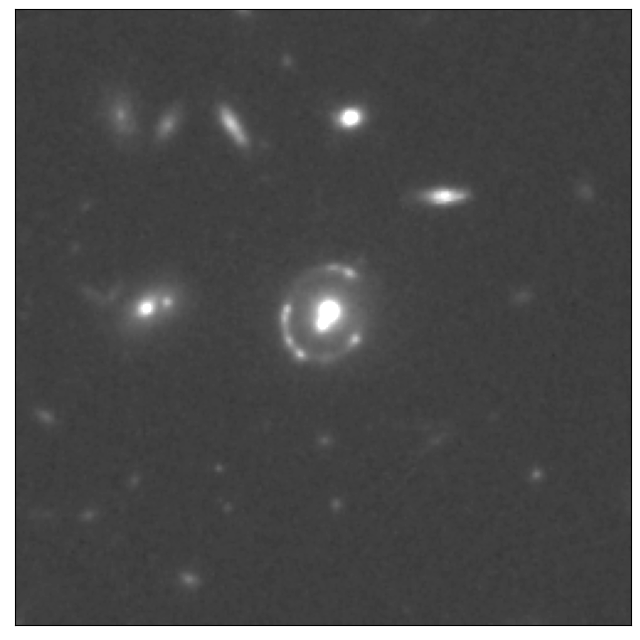
Credit: Tania Barone / AGEL Survey Data Release 2, Harvard Dataverse (doi:10.7910/DVN/ATFVNA); HST program 15867 (PI Xiaosheng Huang). · Image source · Reuse information
Image details
Hubble Space Telescope / WFC3/IR; F140W
CC0 1.0 Universal
- Other names
- DESI-030.4360-27.6618 [2]
Name origin
Published HST target cross-identificationName variants and source provenance
Published spellings and paper abbreviations retained for matching and traceability.
AGEL020145-273942A [2]Barone et al. 2026 final figure data
- Catalog source
- AGEL
- Right ascension
- 30.43611°
02h 01m 44.67s [2] - Declination
- -27.66177°
−27° 39′ 42.37″ - Coordinates
- Equatorial J2000 · adopted catalog position
- Lens → Source
- Not yet classified
- Appearance
- Not yet classified
- Lens redshift
- Not available
- Discovery report
- 2019-05-25 [6]
Background sources
Primary source A [1]
- Source redshift
- 2.52232 [4]
Measurement details
No numerical redshift uncertainty quoted. Survey Qz=4 denotes emission-line measurements; retained in provenance, not a common quality scale.
Method: X-shooter source emission-line spectroscopy, [O III] and [O II].
Source location: v1 Table 2, DESI-030.4360-27.6618 Source row; Figure 25 caption and Section 2 quality definition.
- Einstein radius
- Not available
Evidence & coordinate notes
- Confirmation: Final Figure 5, exact target panel and row; Section 2 describes retained imaging lenses. Checked exclusions: Table 2 p.13 (data issues), Table 3 p.18 (false positives); selected target is not excluded. [1]
- Coordinates: dbf5.txt line 70, Position 42, AGEL020145-273942A / DESI-030.4360-27.6618; byte definitions RAdeg/DEdeg (J2000 degrees), lines 20–21; final Figure 5, PDF p.14. [2]
- Description: Accepted v2 Section3.3.3, exact target; Table1 model parameter and Table2 photometric redshift. Supplementary-feature identity remains uncertain. [5]
- Description: dbf5.txt line 70, Position 42, AGEL020145-273942A / DESI-030.4360-27.6618; byte definitions RAdeg/DEdeg (J2000 degrees), lines 20–21; final Figure 5, PDF p.14. [2]
- Description: Final Section 2 p.4 and Figure 1 caption p.5, exact DESI target; Table 1 p.11 source-image coordinates are not deflector positions. [3]
- Description: v1 Table 2, DESI-030.4360-27.6618 Source row; Figure 25 caption and Section 2 quality definition. [4]
- Discovery date: Jacobs arXiv:1905.10522v1, candidate DESJ0201-2739 ID66305304, no prior-known flag; final full Table 1 same row. Huang grade-B index254 explicitly refers back to Jacobs (d). Public v1 submission metadata: 25 May 2019. [6]
- Source:primary: Final Section 1, PDF p.4, naming convention: A/B/C designate sources; exact final Figure 5 target panel and machine-readable row cited with coordinates. [1]
References
- Barone et al. (2026), The AGEL Survey Data Release 2: A Gravitational Lens Sample for Galaxy Evolution and Cosmology, AJ171,57 (final). DOI: 10.3847/1538-3881/ae1f86
- Barone et al. (2026), final Figure 5 machine-readable data, J2000 target positions and HST names.
- Huang et al. (2026), DESI Strong Lens Foundry I: HST Observations and Modeling with GIGA-Lens, ApJ998,69 (final). DOI: 10.3847/1538-4357/ae22d2
- Jullo et al. (2026), spectroscopic follow-up of DESI lens candidates, arXiv:2607.08562v1.
- Adnan et al. (2025), Investigating the relation between environment and internal structure of massive elliptical galaxies using strong lensing; accepted arXiv:2412.00361v2. DOI: 10.1051/0004-6361/202453239
- Jacobs et al. (2019), An extended catalog of galaxy-galaxy strong gravitational lenses discovered in DES using convolutional neural networks. DOI: 10.3847/1538-4365/ab26b6
- Huang et al. (2021), Discovering New Strong Gravitational Lenses in the DESI Legacy Imaging Surveys; arXiv:2005.04730v3. DOI: 10.3847/1538-4357/abd62b
- Jacobs et al. (2019), full machine-readable Table 1, apjsab26b6t1_mrt.txt.