Catalog ID: GLC-173
AGEL013204-160014A
AGEL013204-160014A (DESI-023.0157-16.0040) is retained in the published AGEL HST lens imaging sample. Huang et al. classify this as a galaxy-scale lens. DESI spectroscopy measures the primary lensed source at redshift 1.5818 ±0.00007. The adopted central-deflector photometric estimate is 0.36 ±0.04. An HST model gives an Einstein radius of 1.403 arcsec with a statistical posterior interval of -0.006/+0.005 arcsec. [4] [5] [2] [3]
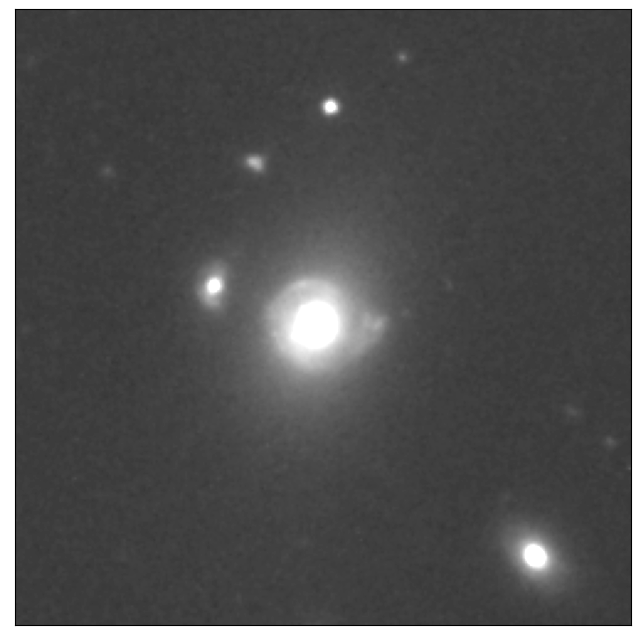
Credit: Tania Barone / AGEL Survey Data Release 2, Harvard Dataverse (doi:10.7910/DVN/ATFVNA); HST program 15867 (PI Xiaosheng Huang). · Image source · Reuse information
Image details
Hubble Space Telescope / WFC3/IR; F140W
CC0 1.0 Universal
- Other names
- DESI-023.0157-16.0040 [2]
Name origin
Published HST target cross-identificationName variants and source provenance
Published spellings and paper abbreviations retained for matching and traceability.
AGEL013204-160014A [2]Barone et al. 2026 final figure data
- Catalog source
- AGEL
- Right ascension
- 23.01570°
01h 32m 03.77s [2] - Declination
- -16.00400°
−16° 00′ 14.40″ - Coordinates
- Equatorial J2000 · adopted catalog position
- Lens → Source
- Galaxy → Galaxy [3]
- Appearance
- Not yet classified
- Lens redshift
- 0.36 [4]
Measurement details
Reported uncertainty: −0.04 / +0.04
Quoted photometric uncertainty, confidence level unspecified. Alternative Zhou/Huang0.492±0.047 retained; prefer the explicit deflector assignment in the modeling study without diagnosing the difference.
Method: Photometric redshift assigned to the central deflector in the target-specific modeling study.
Source location: Accepted v2 Table2, J023.0157-16.0040 row; Section4.2 identifies DESI Legacy Imaging Surveys DR8 photometric catalogue (Duncan2022).
- Discovery report
- 2020-05-07 [6]
- Explore
- External object viewer
Background sources
Primary source A [1]
- Source redshift
- 1.5818 [5]
Measurement details
Reported uncertainty: −0.00007 / +0.00007
Quoted DESI redshift uncertainty in Table2; no additional systematic precision is inferred.
Method: DESI source spectroscopy: [OII] at the optical wavelength limit; not a Keck NIRES detection.
Source location: Final Table2 p.6, DESI J023.0157-16.0040, footnote a; Section2 p.3, Section4 p.6 and Section5 p.9.
- Einstein radius
- 1.403 arcsec [4]
Measurement details
Reported uncertainty: −0.006 / +0.005
Posterior median with16th/84th percentile bounds (paper calls1sigma). Statistical/model-conditional uncertainty; neighboring galaxies masked under the stated negligible-lensing assumption.
Method: HST lens reconstruction: central elliptical power-law deflector plus shear, with logarithmic slope fixed to2.
Source location: Accepted v2 Table1, J023.0157-16.0040; Sections3.1.1,3.3.1,4.1 and AppendixA model row.
Evidence & coordinate notes
- Confirmation: Final Table2 p.6 and Sections2,4: source redshift measured by DESI after the NIRES non-detection. [5]
- Confirmation: Final Figure 5, exact target panel and row; Section 2 describes retained imaging lenses. Checked exclusions: Table 2 p.13 (data issues), Table 3 p.18 (false positives); selected target is not excluded. [1]
- Coordinates: dbf5.txt line 68, Position 40, AGEL013204-160014A / DESI-023.0157-16.0040; byte definitions RAdeg/DEdeg (J2000 degrees), lines 20–21; final Figure 5, PDF p.14. [2]
- Description: Accepted v2 Table2, J023.0157-16.0040 row; Section4.2 identifies DESI Legacy Imaging Surveys DR8 photometric catalogue (Duncan2022). Accepted v2 Table1, J023.0157-16.0040; Sections3.1.1,3.3.1,4.1 and AppendixA model row. [4]
- Description: Final Table2 p.6, DESI J023.0157-16.0040, footnote a; Section2 p.3, Section4 p.6 and Section5 p.9. [5]
- Description: dbf5.txt line 68, Position 40, AGEL013204-160014A / DESI-023.0157-16.0040; byte definitions RAdeg/DEdeg (J2000 degrees), lines 20–21; final Figure 5, PDF p.14. [2]
- Description: Final Section 2 p.4 and Figure 1 caption p.5, exact DESI target; Table 1 p.11 source-image coordinates are not deflector positions. [3]
- Discovery date: Huang arXiv:2005.04730v1 Table 2, exact DESI-023.0157-16.0040 candidate row, independently inspected. Version header and submission history establish 7 May 2020 public report. Current final project table has no prior-reference flag; no universal earliest-discovery claim. [6]
- Source:primary: Final Section 1, PDF p.4, naming convention: A/B/C designate sources; exact final Figure 5 target panel and machine-readable row cited with coordinates. [1]
- System class: Final Figure 1 caption, PDF p.5, DESI-023.0157-16.0040. [3]
References
- Barone et al. (2026), The AGEL Survey Data Release 2: A Gravitational Lens Sample for Galaxy Evolution and Cosmology, AJ171,57 (final). DOI: 10.3847/1538-3881/ae1f86
- Barone et al. (2026), final Figure 5 machine-readable data, J2000 target positions and HST names.
- Huang et al. (2026), DESI Strong Lens Foundry I: HST Observations and Modeling with GIGA-Lens, ApJ998,69 (final). DOI: 10.3847/1538-4357/ae22d2
- Adnan et al. (2025), Investigating the relation between environment and internal structure of massive elliptical galaxies using strong lensing; accepted arXiv:2412.00361v2. DOI: 10.1051/0004-6361/202453239
- Agarwal et al. (2026), DESI Strong Lens Foundry III: Keck Spectroscopy for Strong Lenses Discovered Using Residual Neural Networks, ApJ1001,162 (final). DOI: 10.3847/1538-4357/ae4a9a
- Huang et al., arXiv:2005.04730v1, 7 May 2020, original candidate tables.
- Huang et al. (2021), Discovering New Strong Gravitational Lenses in the DESI Legacy Imaging Surveys; arXiv:2005.04730v3. DOI: 10.3847/1538-4357/abd62b