Catalog ID: GLC-169
AGEL203911-545945A
Confirmed — published expert assessment [1]
AGEL203911-545945A (DESJ2039-5459) is retained in the published AGEL HST lens imaging sample. The earlier catalogue reports a redshift of 0.17 and an arc radius of 3.04 ± 0.64 arcsec. The checked provenance does not securely establish a foreground spectroscopic measurement, and the geometric arc radius is not adopted as a modeled Einstein radius. [3] [2] [4]
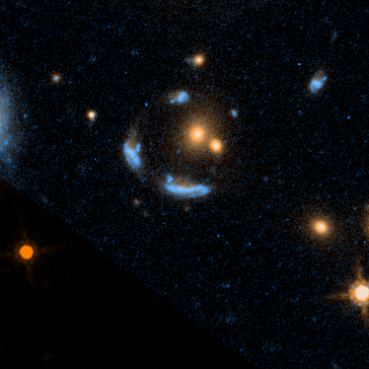
Credit: Tania Barone / AGEL Survey Data Release 2, Harvard Dataverse (doi:10.7910/DVN/ATFVNA); HST program 16773 (PI Karl Glazebrook). Reduced data: Hannah Skobe. · Image source · Reuse information
Image details
Hubble Space Telescope / WFC3/UVIS and WFC3/IR; F200LP, F140W
CC0 1.0 Universal
- Other names
- DESJ2039-5459 [2]
Name origin
Published HST target cross-identificationName variants and source provenance
Published spellings and paper abbreviations retained for matching and traceability.
AGEL203911-545945A [2]Barone et al. 2026 final figure data
- Catalog source
- AGEL
- Right ascension
- 309.79780°
20h 39m 11.47s [2] - Declination
- -54.99590°
−54° 59′ 45.24″ - Coordinates
- Equatorial J2000 · adopted catalog position
- Lens → Source
- Not yet classified
- Appearance
- Not yet classified
- Lens redshift
- Not available
- Discovery report
- 2017 [3]
- Explore
- External object viewer
Background sources
Primary source A [1]
- Source redshift
- Not available
- Einstein radius
- Not available
Evidence & coordinate notes
- Confirmation: Final Figure 3, exact target panel and row; Section 2 describes retained imaging lenses. Checked exclusions: Table 2 p.13 (data issues), Table 3 p.18 (false positives); selected target is not excluded. [1]
- Coordinates: dbf3.txt line 98, Position 70, AGEL203911-545945A / DESJ2039-5459; byte definitions RAdeg/DEdeg (J2000 degrees), lines 20–21; final Figure 3, PDF p.11. [2]
- Description: Table 2, PDF p.32, DESJ2039-5459: arc radius 3.04 ±0.64 arcsec; Section 4, pp.13–14, mean source-image radius and uncertainty definition; Table 3 introduction p.38, DESDM photometric redshift provenance. [3]
- Description: dbf3.txt line 98, Position 70, AGEL203911-545945A / DESJ2039-5459; byte definitions RAdeg/DEdeg (J2000 degrees), lines 20–21; final Figure 3, PDF p.11. [2]
- Description: Final machine-readable Table 1, line 489, DESJ2039-5459, objectID174184226: z=0.17, r_z=1. Byte definitions lines 27–30 and Notes (1)–(3), lines 32–44. Reference 1 points to Diehl; its photometric provenance does not establish secure spectroscopy. [4]
- Discovery date: Diehl 2017 Table 2, DES J2039-5459 (PDF p.32), rank 8, no previous-reference flag. Jacobs final Table 1 ID174184226 explicitly flags it a, previously known, reference 1 (Diehl). Use the primary report year, not a draft creation/acceptance date. [3]
- Source:primary: Final Section 1, PDF p.4, naming convention: A/B/C designate sources; exact final Figure 3 target panel and machine-readable row cited with coordinates. [1]
References
- Barone et al. (2026), The AGEL Survey Data Release 2: A Gravitational Lens Sample for Galaxy Evolution and Cosmology, AJ171,57 (final). DOI: 10.3847/1538-3881/ae1f86
- Barone et al. (2026), final Figure 3 machine-readable data, J2000 target positions and HST names.
- Diehl et al. (2017), The DES Bright Arcs Survey; FERMILAB-PUB-17-138-PPD manuscript (Table 2 pagination cited), published ApJS232,15. DOI: 10.3847/1538-4365/aa8667
- Jacobs et al. (2019), full machine-readable Table 1, apjsab26b6t1_mrt.txt.
- Jacobs et al. (2019), An extended catalog of galaxy-galaxy strong gravitational lenses discovered in DES using convolutional neural networks. DOI: 10.3847/1538-4365/ab26b6