Catalog ID: GLC-163
AGEL060357-355806A
Confirmed — published expert assessment [1]
AGEL060357-355806A is included among the 72 lenses identified in the final AGEL HST imaging assessment. Confirmation here is by published expert assessment; the primary background galaxy has no adopted redshift. The published deflector mass scale is that of a cluster. Additional apparent arc sets remain unassigned relative to AGEL A; their published redshifts and radii are not attached to the primary source. Spectroscopy gives a biweight central foreground cluster redshift of 0.4895 ± 0.0010, with 49 member galaxies. This is preferred to the earlier mean of three foreground measurements, 0.4884 ± 0.0014; neither is a redshift of AGEL A. Jacobs et al. publicly listed the system as a possible lens on 25 May 2019; this is a candidate-report date, not a confirmation date. Huang et al. independently reported it on 7 May 2020. [1] [6] [3] [4] [9] [7] [5] [8]
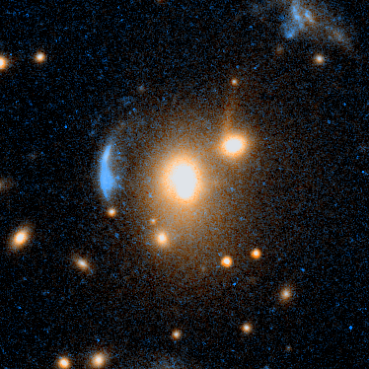
Credit: Tania Barone / AGEL Survey DR2; HST program 16773 (PI Glazebrook); reduction: Hannah Skobe. · Image source · Reuse information
Image details
Hubble Space Telescope / WFC3; F200LP, F140W
CC0 1.0 Universal
- Other names
- DESJ0603-3558 [1]
Name origin
Barone et al. 2026, Figure 3 HST cross-identificationName variants and source provenance
Published spellings and paper abbreviations retained for matching and traceability.
AGEL060357-355806A [1]Barone et al. 2026, Figure 3 data
- Catalog source
- AGEL
- Right ascension
- 90.98540°
06h 03m 56.50s [2] - Declination
- -35.96830°
−35° 58′ 05.88″ - Coordinates
- Equatorial J2000 · adopted catalog position
- Lens → Source
- Cluster → Galaxy [3]
- Appearance
- Not yet classified
- Lens redshift
- 0.4895 [7]
Measurement details
Reported uncertainty: −0.001 / +0.001
Reported uncertainty on the biweight central cluster redshift; §3.3 does not specify its confidence convention. The subsequent 1000-resample bootstrap and 68% spread describe velocity dispersion, not this redshift uncertainty.
Method: Biweight location of spectroscopic galaxy redshifts in the Carousel cluster field (MUSE/GMOS); 49 cluster members
Source location: arXiv:2601.14422v3 §3.2 (57 DECaLS objects; 49 cluster galaxies) and §3.3 first paragraph, HTML S3.SS3.p1: biweight central cluster redshift 0.4895 ± 0.0010; 49 members within 3000 km/s.
- Discovery report
- 2019-05-25 [9]
- Explore
- External object viewer
Background sources
Main arc A (AGEL designation) [1]
- Source redshift
- Not available
- Einstein radius
- Not available
Evidence & coordinate notes
- Confirmation: Final Figure 3, PDF p.11, position 64 (row 8, column 8); dbf3.txt exact row AGEL060357-355806A. §2.1 pp.11–12 identifies 72 lenses after exclusions; Tables 2 p.13 and 3 p.18 checked, target absent. [1]
- Coordinates: Final Figure 3, PDF p.11, position 64 (row 8, column 8); dbf3.txt exact row AGEL060357-355806A. RAdeg/DEdeg headers lines 20–21 explicitly J2000 degrees. [2]
- Description: Final Figure 3, PDF p.11, position 64 (row 8, column 8); dbf3.txt exact row AGEL060357-355806A. §2.1 pp.11–12 for post-exclusion expert lens assessment. [1]
- Description: arXiv:2005.04730v1 Table 1 exact DESI-090.9854-35.9683 row and v1 submission history, 7 May 2020. Actual independent public report; superseded as earliest located report by Jacobs v1 Table 5. [6]
- Description: Table 4, final PDF p.17, row AGEL060357-355806; §3.3.4 p.8 defines deflector scale; table notes distinguish environment. [3]
- Description: arXiv:2005.04730v3 Figure 10 caption, fourth column/fourth system DESI-090.9854-35.9683: apparent source sets 1–4. No AGEL A correspondence. [4]
- Description: arXiv:1905.10522v1 Appendix B Table 5, row A2.T5.4.568: DES Y3A1 object 455978070, 06 03 56.50, -35 58 05.74, blank prior-reference note; caption: possible lenses, 0<grade<2. v1 submission history: 25 May 2019. [9]
- Description: arXiv:2601.14422v3 §3.2 (57 DECaLS objects; 49 cluster galaxies) and §3.3 first paragraph, HTML S3.SS3.p1: biweight central cluster redshift 0.4895 ± 0.0010; 49 members within 3000 km/s. §1 independently attributes identification to Huang2021 and O’Donnell2022. [7]
- Description: arXiv:2408.10320v1 §II identity DESI-090.9854-35.9683/DESJ0603-3558; §III Table 1 foreground La+b, Lc, Ld and paragraph reporting mean cluster redshift. [5]
- Description: arXiv:2602.16077v2 §III first paragraph, S3.p1.1: Carousel coordinates and first-candidate attribution to Jacobs2019 (reference 46), followed independently by Huang2021. [8]
- Discovery date: arXiv:1905.10522v1 Appendix B Table 5, row A2.T5.4.568: DES Y3A1 object 455978070, 06 03 56.50, -35 58 05.74, blank prior-reference note; caption: possible lenses, 0<grade<2. v1 submission history: 25 May 2019. [9]
- Record source: Final Figure 3, PDF p.11, position 64 (row 8, column 8); dbf3.txt exact row AGEL060357-355806A. AGEL catalog inclusion is record provenance, not original discovery credit. [1]
- Source:source a: Final Figure 3, PDF p.11, position 64 (row 8, column 8); dbf3.txt exact row AGEL060357-355806A. §2.1 post-exclusion lens sample; main arc A only, without assigning other visible objects as physical sources. [1]
- System class: Table 4, final PDF p.17, row AGEL060357-355806; §3.3.4 p.8 defines deflector scale; table notes distinguish environment. [3]
References
- Barone et al. (2026), The AGEL Survey Data Release 2, AJ 171, 57; final journal edition. DOI: 10.3847/1538-3881/ae1f86
- Barone et al. (2026), data behind final Figure 3, dbf3.txt.
- Gottemoller et al. (2026), Most Strong Lensing Deflectors in the AGEL Survey Are in Group and Cluster Environments, AJ 171, 218; final journal edition. DOI: 10.3847/1538-3881/ae4480
- Huang et al. (2021), Discovering New Strong Gravitational Lenses in the DESI Legacy Imaging Surveys; arXiv:2005.04730v3. DOI: 10.3847/1538-4357/abd62b
- Sheu et al. (2024), The Carousel Lens; arXiv:2408.10320v1, 19 August 2024.
- Public lens-system report; cited edition and chronology recorded in science dossier.
- O’Donnell et al. (2026), The Carousel Lens I: A Spectroscopic Survey of the Carousel Lens Field; arXiv:2601.14422v3, 8 September 2026; published OJA 10 September 2026. DOI: 10.33232/001c.170181
- Urcelay et al. (2026), The Carousel Lens II: Cosmological Constraints with GIGA-Lens; arXiv:2602.16077v2.
- Jacobs et al. (2019), An extended catalog of galaxy-galaxy strong gravitational lenses discovered in DES using convolutional neural networks; public manuscript v1, 25 May 2019. DOI: 10.3847/1538-4365/ab26b6