Catalog ID: GLC-147
AGEL224621+223338A
Confirmed — spectroscopy [1]
AGEL224621+223338A is a confirmed AGEL strong gravitational lens with a spectroscopically identified background galaxy. [1] [3]
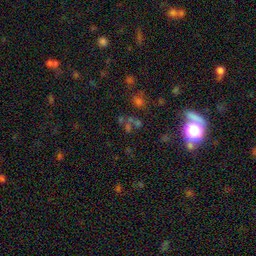
Credit: Legacy Surveys / D. Lang (Perimeter Institute) · Image source · Reuse information
Image details
/ ;
Creative Commons Attribution 4.0 International (CC BY 4.0)
- Other names
- No additional distinct designations
Name variants and source provenance
Published spellings and paper abbreviations retained for matching and traceability.
AGEL224621+223338A [1]Barone et al. 2026
- Catalog source
- AGEL
- Right ascension
- 341.58817°
22h 46m 21.16s [2] - Declination
- 22.56045°
+22° 33′ 37.62″ - Coordinates
- Equatorial J2000 · adopted catalog position
- Lens → Source
- Galaxy → Galaxy [3]
- Appearance
- Not yet classified
- Lens redshift
- 0.531 [4]
Measurement details
No object-specific error is provided for this literature column. Later Barone Table 1 leaves the foreground entry blank; no retraction stated. Gottemoller Table 2 p.15 also uses 0.531.
Method: BOSS spectroscopy as attributed in Tran et al. (2022).
Source location: Final Table 1, PDF p.9, AGEL 224621+223338, zLit=0.531, source BOSS; table notes (c)–(d).
- Discovery report
- Not available
Background sources
Main arc A (AGEL designation) [1]
- Source redshift
- 2.257 [1]
Measurement details
Reported uncertainty: −0.0005 / +0.0005
Formal uncertainty from §3.1. AGEL quality flag 3: reliable multiple-feature redshift. General ISM/rotation caveats are not asserted specifically for this source.
Method: Spectroscopy; JONES_2019B_U058_ESI; Gaussian feature fitting and/or MARZ templates.
Source location: Final Table 1, PDF p.9, exact row AGEL224621+223338A; machine-readable Table 1 line 173. §3.1 pp.14–16, especially p.16.
- Einstein radius
- 1.8 arcsec [3]
Measurement details
Reported uncertainty: −0.9 / +0.9
Approximate Einstein radius, not a detailed mass model. Error includes half arc width and model-calibrated systematic scatter. Target-specific fit family not tabulated; blended-line fits are upper-limit estimators (§3.3.1).
Method: MCMC fit to source-image geometry in DECaLS; ring, line, or blended-line family.
Source location: Table 2, final PDF p.15, row AGEL224621+223338, theta_E; §3.3.1 pp.6–7 and §3.3.2 p.7.
Evidence & coordinate notes
- Confirmation: Final Table 1, PDF p.9, exact row AGEL224621+223338A; machine-readable Table 1 line 173. §3.1 pp.14–16: redshift methodology and reliability; Table 3 p.18 excludes false positives. [1]
- Coordinates: Table 1 line 173, AGEL224621+223338A; RAdeg/DEdeg J2000 degree definitions lines 25–26. Exact reported strings retained. [2]
- Description: Final Table 1, PDF p.9, exact row AGEL224621+223338A; machine-readable Table 1 line 173. §3.1 pp.14–16 for spectral qualifications. [1]
- Description: Table 2, final PDF p.15, row AGEL224621+223338; §3.3.4 p.8 defines deflector scale; table notes distinguish environment. [3]
- Record source: Final Table 1, PDF p.9, exact row AGEL224621+223338A; machine-readable Table 1 line 173. AGEL catalog inclusion is record provenance, not original discovery credit. [1]
- Source:source a: Final Table 1, PDF p.9, exact row AGEL224621+223338A; machine-readable Table 1 line 173. Table note (1), p.10: A main arc, B second arc; source and deflector columns kept distinct. [1]
- System class: Table 2, final PDF p.15, row AGEL224621+223338; §3.3.4 p.8 defines deflector scale; table notes distinguish environment. [3]
References
- Barone et al. (2026), The AGEL Survey Data Release 2, AJ 171, 57; final journal edition. DOI: 10.3847/1538-3881/ae1f86
- Barone et al. (2026), final Table 1 machine-readable data.
- Gottemoller et al. (2026), Most Strong Lensing Deflectors in the AGEL Survey Are in Group and Cluster Environments, AJ 171, 218; final journal edition. DOI: 10.3847/1538-3881/ae4480
- Tran et al. (2022), The AGEL Survey: Spectroscopic Confirmation of Strong Gravitational Lenses Selected Using Convolutional Neural Networks, AJ 164, 148. DOI: 10.3847/1538-3881/ac7da2