Catalog ID: GLC-143
AGEL204312-060954A
AGEL204312-060954A is a confirmed AGEL strong gravitational lens with a primary background galaxy at spectroscopic redshift 1.892. The foreground redshift is 0.791. The published deflector-scale assessment is cluster-scale. Its quoted Einstein radius is an approximate image-geometry estimate, not a precision mass-model result. [1] [5]
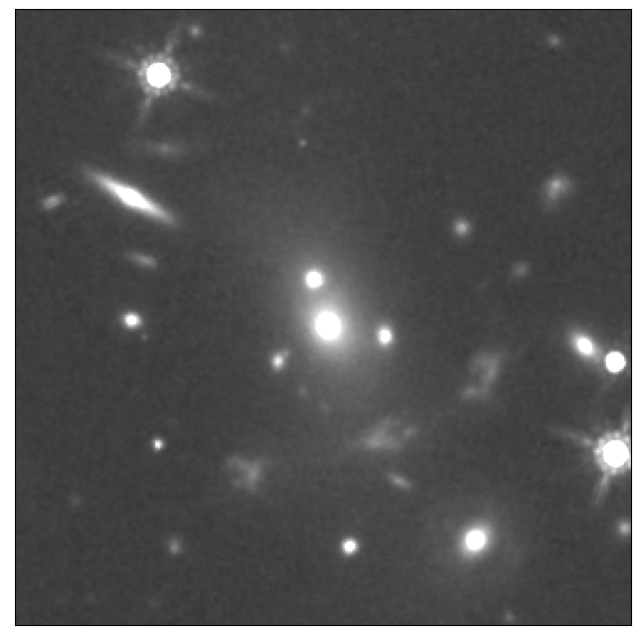
Credit: Tania Barone / AGEL Survey DR2; HST program 15867 (PI Huang). · Image source · Reuse information
Image details
Hubble Space Telescope / WFC3; F140W
CC0 1.0 Universal
- Other names
- DESI-310.8019-06.1649 [3]
Name origin
Barone et al. 2025 arXiv v1 HST mappingName variants and source provenance
Published spellings and paper abbreviations retained for matching and traceability.
AGEL204312-060954A [1]Barone et al. 2026
- Catalog source
- AGEL
- Right ascension
- 310.80200°
20h 43m 12.48s [1] [2] - Declination
- -6.16490°
−06° 09′ 53.64″ - Coordinates
- Equatorial J2000 · adopted catalog position
- Lens → Source
- Cluster → Galaxy [5]
- Appearance
- Arc [1]
- Lens redshift
- 0.791 [1]
Measurement details
Reported uncertainty: −0.0005 / +0.0005
Formal uncertainty from Section 3.1; AGEL DR2 flag 3 (multiple reliable features). In group/cluster systems this can be one member, not necessarily the brightest galaxy or an ensemble velocity.
Method: Spectroscopy: JONES_2020B_U044_ESI; Gaussian feature fits and/or MARZ templates; barycentric convention.
Source location: Table 1, final journal PDF p.9, row AGEL204312-060954A; column 5–7; Table 1 note p.10 (literature marker); Section 3.1 pp.14–16.
- Discovery report
- Not available
- Explore
- External object viewer
Background sources
Primary spectroscopic source A [1]
- Source redshift
- 1.892 [1]
Measurement details
Reported uncertainty: −0.0005 / +0.0005
Formal uncertainty from Section 3.1; reliable multiple-feature spectrum (AGEL DR2 flag 3). ISM offsets and rotation can affect systemic interpretation; no target-specific cause is asserted.
Method: Spectroscopy: KACPRZAK_2020B_W127_NIRES; Gaussian feature fits and/or MARZ templates (individual fitting choice not specified); barycentric redshift.
Source location: Table 1, final journal PDF p.9, row AGEL204312-060954A; column 2–4; Section 3.1 pp.14–16 (formal errors/caveats), Introduction p.4 (barycentric convention).
- Einstein radius
- 8.8 arcsec [5]
Measurement details
Reported uncertainty: −1.9 / +1.9
Published approximate image-geometry estimate with arc-width and model-scatter uncertainty. The blended-line variant is an upper limit; the table does not identify this target’s variant. Not a precise mass-model radius.
Method: MCMC fitting of DECaLS source-image geometry (ring/line/blended line); exact target model variant unreported.
Source location: Table 4, final PDF p.17, row AGEL204312-060954, theta_E column 4 (arcsec); Sections 3.3.1–3.3.3 pp.6–8; Table 2 notes p.15.
Evidence & coordinate notes
- Aliases: Historical v1 Appendix HST-name mapping, exact HTML row A0.T3.2.1.29: 27 | AGEL204312-060954A | DESI-310.8019-06.1649 | 310.80200 | -6.16490. Used only for cross-identification. [3]
- Appearance:arc: Table 1, final journal PDF p.9, row AGEL204312-060954A; column 1 and Table 1 note p.10: A labels the main lensed arc. [1]
- Confirmation: Table 1, final journal PDF p.9, exact row AGEL204312-060954A; table note p.10; Sections 3.1–3.5 pp.14–16. Section 4.1 pp.17–18 and Table 3 p.18: target absent from false positives. Main source has spectroscopy. [1]
- Confirmation: Section 2.2 PDF p.4: 50/51 HST systems confirmed, exception DESI-186.8281+17.4311; Table 1 p.11 row DESI-310.8019-06.1649; Figure 5 p.9. This target is not the exception. [4]
- Coordinates: Table 1, final journal PDF p.9, row AGEL204312-060954A; column 10–11; position of deflector system, not source-plane coordinates. [1]
- Coordinates: Table 1 MRT line 158, AGEL204312-060954A; byte definitions RAdeg 145–153 and DEdeg 155–163: degree, J2000, F9.5; note 1 defines main arc A. [2]
- Description: Table 1, final journal PDF p.9, exact row AGEL204312-060954A; table note p.10; Sections 3.1–3.5 pp.14–16. Source and deflector columns distinguished; candidate-catalog attribution is not necessarily first discovery (Section 3 p.14). [1]
- Description: Table 4, final journal PDF p.17, row AGEL204312-060954, columns 2–5 and 9–11; Table 2 notes p.15; Section 3.3.4 p.8. Approximate theta_E method and caveats Sections 3.3.1–3.3.3 pp.6–8. [5]
- Record source: Table 1, final journal PDF p.9, exact row AGEL204312-060954A; table note p.10; Sections 3.1–3.5 pp.14–16. AGEL DR2 membership; candidate-origin column 9 retained separately in dossier. [1]
- Source:a: Table 1, final journal PDF p.9, exact row AGEL204312-060954A; table note p.10; Sections 3.1–3.5 pp.14–16. Introduction p.4: A/B/C differentiate sources; table note p.10: A is main arc. [1]
- System class: Table 4, final journal PDF p.17, row AGEL204312-060954, columns 2–5 and 9–11; Table 2 notes p.15; Section 3.3.4 p.8. Deflector-scale column 9 adopted, not environment column 10 or visual column 11. [5]
References
- Barone et al. (2026), The AGEL Survey Data Release 2, AJ 171, 57. Final journal edition. DOI: 10.3847/1538-3881/ae1f86
- Barone et al. (2026), AJ 171, 57, Table 1 machine-readable data; J2000 coordinates.
- Barone et al. (2025), arXiv:2503.08041v1. Historical edition; cross-identifications and non-adopted alternatives.
- Huang et al. (2026), DESI Strong Lens Foundry I, ApJ 998, 69. Final journal edition. DOI: 10.3847/1538-4357/ae22d2
- Gottemoller et al. (2026), Most Strong Lensing Deflectors in the AGEL Survey Are in Group and Cluster Environments, AJ 171, 218. Final 18-page journal edition. DOI: 10.3847/1538-3881/ae4480