Catalog ID: GLC-12
Cheshire Cat
Confirmed — combined [3]
The Cheshire Cat is a group gravitational lens with two dominant elliptical galaxies and four identified background galaxies. The primary southern arc is a galaxy at redshift 0.966. Coordinates and the listed deflector redshift refer to the eastern eye, not the group centroid. The adopted 9.0 arcsecond radius is an approximate HST arc-circle estimate centered between the eyes. [2] [3]
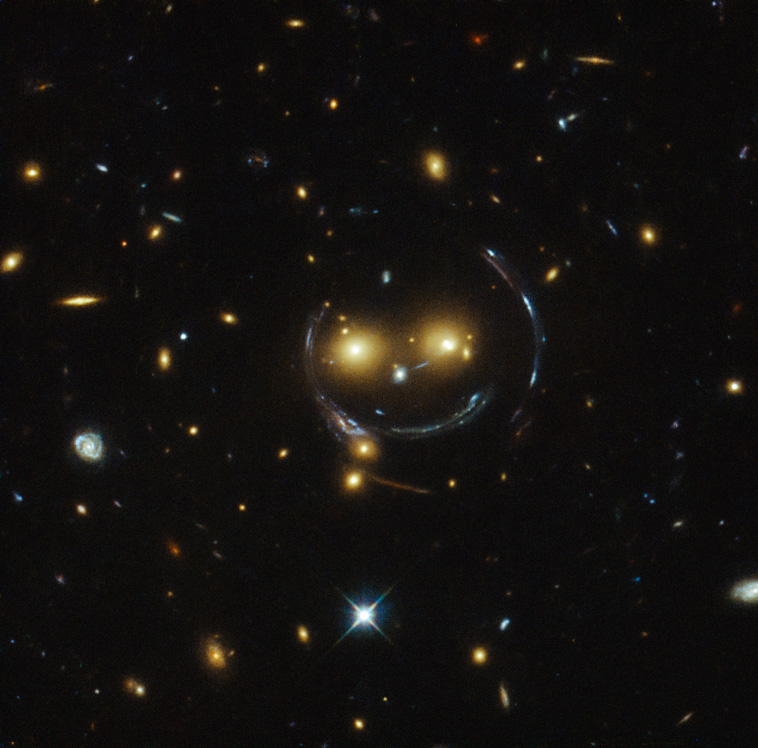
Credit: NASA & ESA Acknowledgement: Judy Schmidt (geckzilla.org) · Image source · Reuse information
Image details
Hubble Space Telescope / WFPC2; WFC3; WFPC2: B (450 nm), V (606 nm), I (814 nm); WFC3: YJ (1.1 μm)
Field of view: 1.26 × 1.24 arcminutes
Orientation: North is 12.4° right of vertical
CC BY 4.0
- Other names
- SDSS J1038+4849 [1]
Name origin
CASSOWARY primary literatureCSWA 2 [1]Name origin
CASSOWARY primary literatureName variants and source provenance
Published spellings and paper abbreviations retained for matching and traceability.
Cheshire Cat [1]CASSOWARY primary literature
- Catalog source
- CASSOWARY
- Right ascension
- 159.68160000°
10h 38m 43.58s [2] - Declination
- 48.82161944°
+48° 49′ 17.83″ - Coordinates
- Equatorial J2000 · adopted catalog position
- Lens → Source
- Group → Galaxy [2]
- Appearance
- Arc [2]
- Lens redshift
- 0.425845 [2]
Measurement details
Reported uncertainty: −0.00014 / +0.00014
Eastern dominant galaxy; not mean group or western-eye redshift.
Method: Gemini/GMOS galaxy spectroscopy; eastern eye only
Source location: Table 1 p.5, ID 972 / G1(E), z and redshift-error columns
- Discovery report
- Not available
- Explore
- External object viewer
Background sources
Primary southern-arc background galaxy (G knot) [3]
- Source redshift
- 0.966 [3]
Measurement details
Numerical uncertainty not supplied for this source in the inspected measurement. Single-line interpretation is discussed in section 3; not an AGEL quality flag.
Method: APO 3.5m/DIS spectroscopy of southern G knot, [O II] 3727
Source location: Section 3.1 p.5; Table 2 p.13, SDSS J1038+4849
- Einstein radius
- 9.0 arcsec [2]
Measurement details
Reported uncertainty: −1.5 / +1.5
Approximate center/radius uncertainty (~1.5 arcsec), not a statistical model posterior. Center lies between eye galaxies; retained z=0.97 is rounded source identification.
Method: HST arc-circle radius fitted by eye; approximate Einstein radius
Source location: Section 6.1 p.11: first radius (9.0 arcsec) corresponds to z=0.97; section 5 p.8 circle procedure
Background galaxy at reported z=0.80 [2]
- Source redshift
- Not available
- Einstein radius
- Not available
Background galaxy at reported z=2.20 [2]
- Source redshift
- Not available
- Einstein radius
- Not available
Background galaxy at reported z=2.78 [2]
- Source redshift
- Not available
- Einstein radius
- Not available
Evidence & coordinate notes
- Appearance:arc: Section 5 p.8 and Figure 4: multiple arcs and knots. [2]
- Confirmation: Sections 3 and 3.1 pp.4-5: confirmed lens sample; southern G knot spectroscopy at z=0.966. [3]
- Coordinates: Irwin accepted manuscript Table 1 p.5 ID 972 G1(E); J2000 units note p.6. Native RA 10 38 43.584 (h m s), Dec +48 49 17.83 (deg arcmin arcsec). RAReported/DECReported are converted display degrees 159.68160000/48.82161944, rounded to 8 decimals, not literal source degree values. Source precision: 0.001 s time/0.01 arcsec; not accuracy. Eastern eye, not group center. [2]
- Description: Abstract and sections 2, 5 p.8, 6.1 p.11: merging group system, two eye galaxies and four background galaxies; arc radii are geometric approximations. [2]
- Description: Section 3.1 p.5: primary southern G knot at z=0.966; Table 2 p.13. [3]
- Source:primary: Section 3.1 p.5; G knot is one image of the primary galaxy. [3]
- Source:source 080: Accepted manuscript section 5 p.8: four physical background galaxies; knot cross-map not adopted. [2]
- Source:source 220: Accepted manuscript section 5 p.8: four physical background galaxies; knot cross-map not adopted. [2]
- Source:source 278: Accepted manuscript section 5 p.8: four physical background galaxies; knot cross-map not adopted. [2]
- System class: Abstract; sections 2, 5 p.8 and 6.1 p.11: group lens with background galaxies [2]
References
- Belokurov et al. (2009), Two New Large Separation Gravitational Lenses from SDSS; Cheshire Cat analysis, arXiv:0806.4188v2.
- Irwin et al. (2015), The Cheshire Cat Gravitational Lens: The Formation of a Massive Fossil Group, ApJ 806, 268; accepted manuscript v1 inspected. DOI: 10.1088/0004-637X/806/2/268
- Kubo et al. (2009), The Sloan Bright Arcs Survey: Six Strongly Lensed Galaxies at z=0.4-1.4, ApJ 696, L61; arXiv manuscript inspected. DOI: 10.1088/0004-637X/696/1/L61