Catalog ID: GLC-114
AGEL103027-064109A
Confirmed — spectroscopy [1]
AGEL103027-064109A is a spectroscopically confirmed AGEL gravitational lens. Gottemoller et al. classify the deflector as group-scale; their cluster-scale environment estimate is a separate quantity. [1] [3]
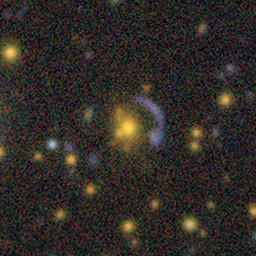
Credit: Legacy Surveys / D. Lang (Perimeter Institute) · Image source · Reuse information
Image details
/ ;
Creative Commons Attribution 4.0 International (CC BY 4.0)
- Other names
- No additional distinct designations
Name variants and source provenance
Published spellings and paper abbreviations retained for matching and traceability.
AGEL103027-064109A [1]AGEL DR2
- Catalog source
- AGEL
- Right ascension
- 157.61347°
10h 30m 27.23s [1] [2] - Declination
- -6.68582°
−06° 41′ 08.95″ - Coordinates
- Equatorial J2000 · adopted catalog position
- Lens → Source
- Group → Galaxy [3]
- Appearance
- Not yet classified
- Lens redshift
- 0.468 [1]
Measurement details
Reported uncertainty: −0.0005 / +0.0005
Formal uncertainty only; measured foreground galaxy, not a group-average redshift.
Method: Spectroscopy, Keck/ESI; survey feature/template fitting.
Source location: Table 1, final journal PDF p8, row AGEL103027-064109A, columns 5-7; Section 3.1 pp15-16.
- Discovery report
- Not available
- Explore
- External object viewer
Background sources
AGEL103027-064109A primary background source [1]
- Source redshift
- 1.583 [1]
Measurement details
Reported uncertainty: −0.0005 / +0.0005
Formal uncertainty only; multiple well-detected features. Object-specific systematic error is not quantified; Section 3.1 discusses possible velocity offsets and internal rotation without assigning them to this target.
Method: Spectroscopy, Keck/NIRES; Gaussian feature fits and/or MARZ templates (survey method).
Source location: Table 1, final journal PDF p8, row AGEL103027-064109A, columns 2-4; Section 3.1 pp15-16.
- Einstein radius
- 5.4 arcsec [3]
Measurement details
Reported uncertainty: −1.3 / +1.3
Approximate image-geometry radius, not a detailed mass-model critical radius. Arc-width errors and model-systematic scatter are discussed in Sections 3.3.2-3.3.3.
Method: DECaLS image geometry fitted by MCMC (ring or image-counterimage separation); target-specific branch unspecified in table.
Source location: Table 4 p17, row AGEL103027-064109, column 4; Sections 3.3.1-3.3.3 pp6-8.
Evidence & coordinate notes
- Confirmation: Table 1, final journal PDF p8, row AGEL103027-064109A; Section 1.2 p3 and Section 4.2 p18 (spectroscopic sample); Section 4.1 pp17-18 and Table 3 p18 false-positive exceptions checked: target absent. [1]
- Coordinates: Table 1, final journal PDF p8, row AGEL103027-064109A, columns 10-11 (system/deflector position). [1]
- Coordinates: Byte definitions RAdeg (145-153), DEdeg (155-163): decimal degrees, J2000; exact row AGEL103027-064109A. [2]
- Description: Table 1, final journal PDF p8, row AGEL103027-064109A; Section 3.1 pp14-16 (spectroscopy, flags and uncertainty); Section 1.2 p3 (survey scope). [1]
- Description: Table 4 p17, row AGEL103027-064109, columns 4-11; Table 2 notes p15; Section 3.3.4 p8. [3]
- Source:a: Table 1, final journal PDF p8, row AGEL103027-064109A, columns 1-4; Table 1 note (1) p10 defines A as main arc. Multiple images do not create extra physical source components. [1]
- System class: Table 4 p17, row AGEL103027-064109, columns 4-11; Table 2 notes p15; Section 3.3.4 p8. [3]
References
- Barone et al. (2026), AGEL Data Release 2, AJ 171, 57; final journal edition DOI: 10.3847/1538-3881/ae1f86
- Barone et al., official Table 1 machine-readable data and byte definitions
- Gottemoller et al. (2026), AGEL deflector scales and environments, AJ 171, 218; final-format edition DOI: 10.3847/1538-3881/ae4480