Catalog ID: GLC-100
AGEL080820+103142A
AGEL080820+103142A is an AGEL gravitational lens. Gottemoller et al. classify the deflector as galaxy-scale; their separately estimated group environment does not define the lens scale. Two explicitly distinct source planes are reported: A at 1.303 and B at 1.452; the older source redshift 1.23742 is not adopted. [5] [1] [3]
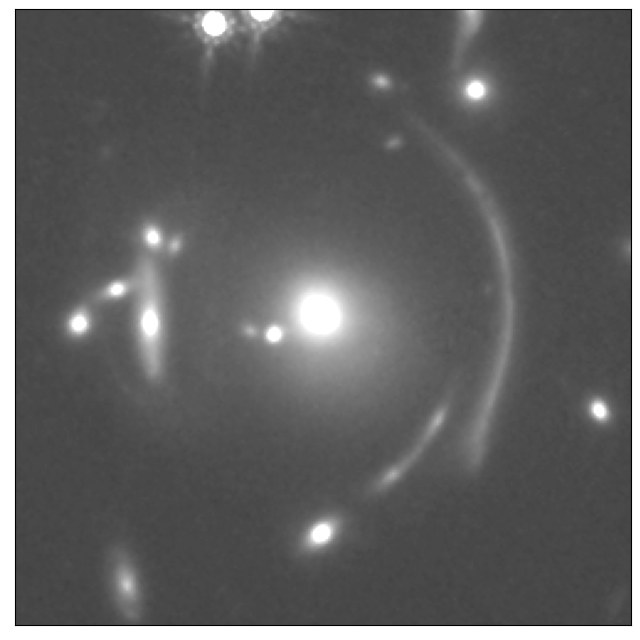
Credit: Tania Barone / AGEL Survey; HST program 15867 (PI Huang) · Image source · Reuse information
Image details
Hubble Space Telescope / WFC3/IR; F140W
CC0 1.0
- Other names
- DESI-122.0852+10.5284 [5]
Name origin
AGEL HST cross-identificationName variants and source provenance
Published spellings and paper abbreviations retained for matching and traceability.
AGEL080820+103142A [1]AGEL DR2
- Catalog source
- AGEL
- Right ascension
- 122.08520°
08h 08m 20.45s [1] [2] - Declination
- 10.52840°
+10° 31′ 42.24″ - Coordinates
- Equatorial J2000 · adopted catalog position
- Lens → Source
- Galaxy → Galaxy [1] [3]
- Appearance
- Not yet classified
- Lens redshift
- 0.475 [1]
Measurement details
Literature SDSS value reproduced by AGEL; no object-specific uncertainty supplied in Table 1. No AGEL formal error assigned to this external measurement.
Method: Spectroscopy, SDSS literature spectroscopy
Source location: Table 1, PDF p7, row AGEL080820+103142A, columns 5-7; Section 3.1 pp15-16.
- Discovery report
- Not available
- Explore
- External object viewer
Background sources
AGEL080820+103142A background source [1]
- Source redshift
- 1.303 [1]
Measurement details
Reported uncertainty: −0.0005 / +0.0005
Formal uncertainty only. Multiple well-detected spectral features; object-specific systematic errors are not quantified. Section 3.1 also discusses possible interstellar-line velocity offsets and internal rotation; neither is assigned here.
Method: Spectroscopy, Keck/ESI; Gaussian-feature fitting and/or MARZ templates (survey method).
Source location: Table 1 p7, row AGEL080820+103142A, columns 2-4; Section 3.1 pp15-16.
- Einstein radius
- Not available
AGEL080820+103142B background source [1]
- Source redshift
- 1.452 [1]
Measurement details
Reported uncertainty: −0.0005 / +0.0005
Formal uncertainty only. Multiple well-detected spectral features; object-specific systematic errors are not quantified. Section 3.1 also discusses possible interstellar-line velocity offsets and internal rotation; neither is assigned here.
Method: Spectroscopy, Keck/ESI; Gaussian-feature fitting and/or MARZ templates (survey method).
Source location: Table 1 p7, row AGEL080820+103142B, columns 2-4; Section 3.1 pp15-16.
- Einstein radius
- Not available
Evidence & coordinate notes
- Confirmation: Table 1, PDF p7, row AGEL080820+103142A; Sections 3.1 pp14-16 and 4.2 p18: accepted sample has deflector and/or source spectroscopy; Table 3 p18 false-positive exceptions exclude this target. [1]
- Confirmation: Section 2.2 p4: 50/51 HST systems confirmed, sole ambiguous exception DESI-186.8281+17.4311; exact target in Table 1 p11 and Figure 2 p6. This target is not that exception. [4]
- Coordinates: Table 1, PDF p7, row AGEL080820+103142A, columns 10-11; decimal degrees, published system/deflector pointing. [1]
- Coordinates: Table 2 pp8-9 J2000 column headers establish AGEL survey convention; applied to DR2 coordinates without epoch conversion. [2]
- Description: Historical name mapping only: Appendix HST mapping / Table 1 exact AGEL designation; final journal science adopted separately. [5]
- Description: Table 1, PDF p7, row AGEL080820+103142A; Section 3.1 pp15-16 for redshift interpretation; source designation note p10. [1]
- Description: Table 3 p16, row AGEL080820+103142: deflector scale and environment are separate columns. [3]
- Source:source a: Table 1 p7, row AGEL080820+103142A; p10 note: A main arc, B second arc; these are author source labels, not counts of images. [1]
- Source:source b: Table 1 p7, row AGEL080820+103142B; p10 note: A main arc, B second arc; these are author source labels, not counts of images. [1]
- System class: Section 4.3 pp19-20, Table 4 p21 row AGEL080820+103142, Figure 13: explicitly galaxy-scale double-source lens; local environment remains uncertain. [1]
- System class: Table 3 p16, row AGEL080820+103142, col9 Defl. Scale=Galaxy; Table 2 notes p15; Section 3.3.4 p8. [3]
References
- Barone et al. (2026), The AGEL Survey Data Release 2, AJ 171, 57; final journal version DOI: 10.3847/1538-3881/ae1f86
- Tran et al. (2022), AGEL survey first spectroscopic release, AJ 164, 148 DOI: 10.3847/1538-3881/ac7da2
- Gottemoller et al. (2026), Most Strong Lensing Deflectors in the AGEL Survey Are in Group and Cluster Environments, AJ 171, 218 DOI: 10.3847/1538-3881/ae4480
- Huang et al. (2026), DESI Strong Lens Foundry. I. HST Observations and Modeling with GIGA-Lens, ApJ 998, 69 DOI: 10.3847/1538-4357/ae22d2
- Barone et al. (2025), AGEL DR2, arXiv:2503.08041v1; historical HST name mapping