Catalog ID: GLC-10
Cosmic Horseshoe
Confirmed — spectroscopy [1] [4]
A massive foreground galaxy bends the light of a more distant star-forming galaxy into a nearly complete Einstein ring. A second background source produces a radial arc, making the Cosmic Horseshoe a system with two distinct source planes. [1] [4]
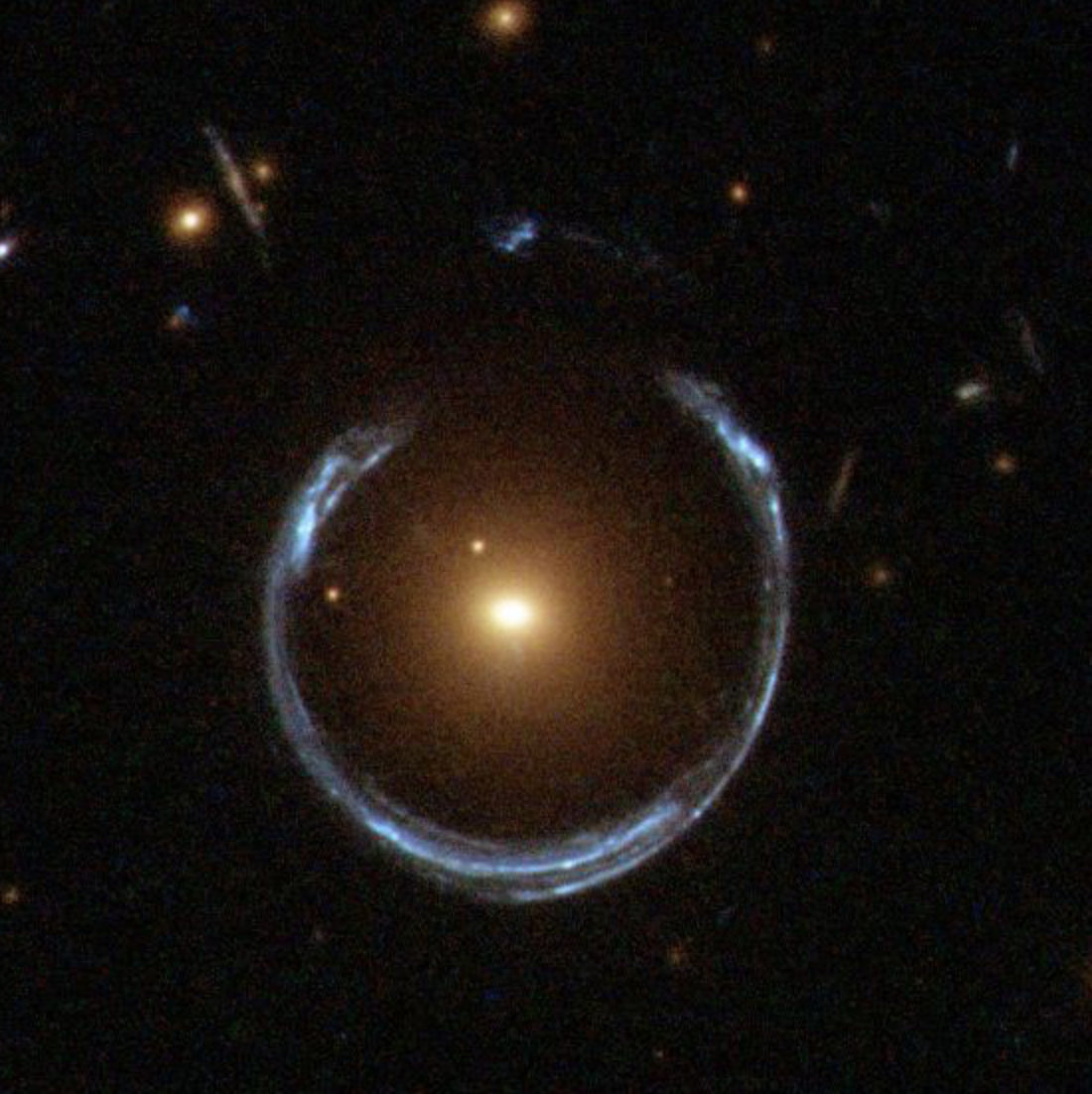
Credit: ESA/Hubble & NASA · Image source · Reuse information
Image details
Hubble Space Telescope / WFC3; Optical B, V; infrared I (publisher labels)
CC BY 4.0; credit required; primary image is a pre-existing crop
- Other names
- SDSS J114833.14+193003.2 [2]
Name origin
SDSS designation in Diehl et al. (2009), section 4.3J1148+1930 [4]Name origin
Schuldt et al. (2019), titleName variants and source provenance
Published spellings and paper abbreviations retained for matching and traceability.
Cosmic Horseshoe [1]Belokurov et al. (2007)
- Catalog source
- Cited Paper
- Right ascension
- 177.1381°
11h 48m 33.14s [2] - Declination
- 19.5008°
+19° 30′ 02.88″ - Coordinates
- Equatorial J2000 · adopted catalog position
- Lens → Source
- Galaxy → Galaxy [1]
- Appearance
- Partial ring [1]Arc [4]
- Lens redshift
- 0.4457 [2]
Measurement details
Reported uncertainty: −0.0003 / +0.0003
Published symmetric uncertainty; confidence level not specified in this passage.
Method: SDSS DR7 spectroscopy
Source location: Section 4.3; Table 4
- Discovery report
- 2007-06-15 [1]
- Explore
- External object viewer
Background sources
Tangential arc / Horseshoe ring source [3]
- Source redshift
- 2.38115 [3]
Measurement details
Reported uncertainty: −0.00006 / +0.00006
1-sigma uncertainty on the stellar-line mean; not a separate quoted uncertainty on all systemic tracers.
Method: Stellar photospheric absorption-line spectroscopy; adopted systemic redshift
Source location: Section 4.1 and Table 1
- Einstein radius
- 5.0 arcsec [2]
Measurement details
Reported uncertainty: −0.3 / +0.3
Published symmetric uncertainty; model/measurement dependent.
Method: Simple circular fit to the ring
Source location: Section 4.3; Table 4
Radial arc source [4]
- Source redshift
- 1.961 [4]
Measurement details
Reported uncertainty: −0.001 / +0.001
Published symmetric uncertainty.
Method: Gemini/GNIRS spectroscopy of radial-arc counterimage
Source location: Abstract; section 2; Figure 2
- Einstein radius
- Not available
Additional images
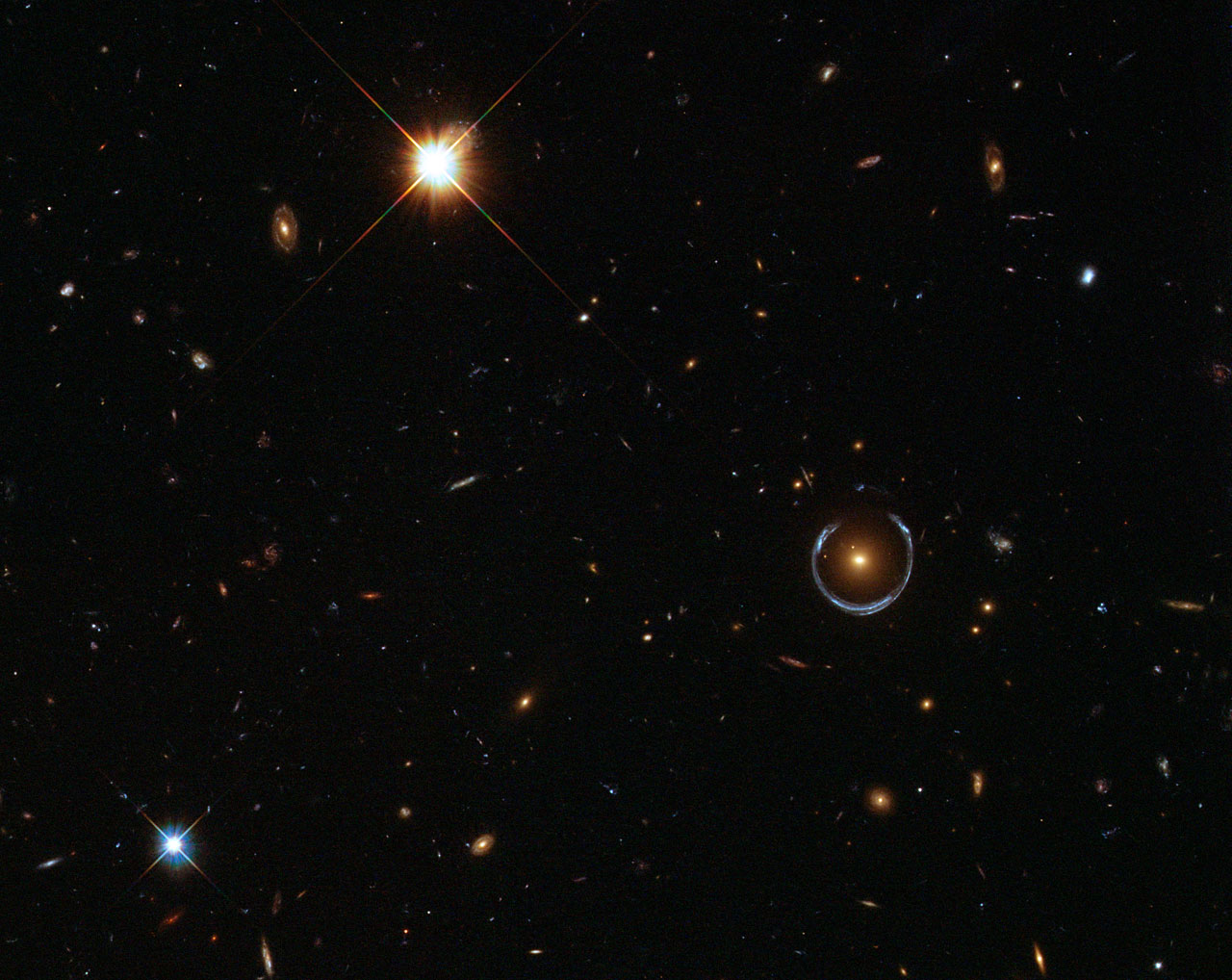
Credit: ESA/Hubble & NASA · Image source · Reuse information
Image details
Hubble Space Telescope / WFC3; Optical B, V; infrared I (publisher labels)
Field of view: 2.14 × 1.70 arcmin (publisher coordinate metadata)
Orientation: North 92.1° right of vertical (publisher metadata)
CC BY 4.0; credit required; primary image is a pre-existing crop
Evidence & coordinate notes
- Confirmation: Abstract and discovery/follow-up section [1]
- Confirmation: Abstract and section 2: second source spectroscopy [4]
- Coordinates: Table 1, SDSS J114833.14+193003.2 row, J2000 degrees [2]
- Description: Abstract [1]
- Description: Abstract and section 2 [4]
- Discovery date: arXiv version 1 submission: 15 June 2007; earliest public report located [1]
- System class: Abstract: luminous red lens galaxy and star-forming source galaxy [1]
References
- Belokurov et al. (2007), The Cosmic Horseshoe: Discovery of an Einstein Ring around a Giant Luminous Red Galaxy, ApJ 671, L9–L12. DOI: 10.1086/524948
- Diehl et al. (2009), The Sloan Bright Arcs Survey: Four Strongly Lensed Galaxies with Redshift > 2, ApJ 707, 686–692. DOI: 10.1088/0004-637X/707/1/686
- Quider et al. (2009), The ultraviolet spectrum of the gravitationally lensed galaxy the Cosmic Horseshoe: a close-up of a star-forming galaxy at z ~ 2, MNRAS 398, 1263–1278. DOI: 10.1111/j.1365-2966.2009.15234.x
- Schuldt et al. (2019), Inner dark matter distribution of the Cosmic Horseshoe (J1148+1930) with gravitational lensing and dynamics, A&A 631, A40. DOI: 10.1051/0004-6361/201935042